Ask any CISO how confident they are in their cloud security posture, and you'll usually get a version of the same answer: "pretty confident, but ask me again after the next audit." That hesitation is telling. Cloud environments change by the hour — new services spin up, permissions get tweaked, third-party integrations get bolted on — and most security teams are still measuring their posture with tools built for a slower, more static world.
The result isn't a lack of security investment. Most enterprises have a CSPM tool, a SIEM, an IAM policy, and a compliance checklist a mile long. The problem is that these tools are all pointed at the risks everyone already knows about — public S3 buckets, unpatched CVEs, weak passwords — while a handful of quieter, structural blind spots quietly accumulate risk in the background.
Here are the four that show up again and again, even in organizations that consider themselves cloud-mature.
1. Identity Sprawl That Nobody Owns
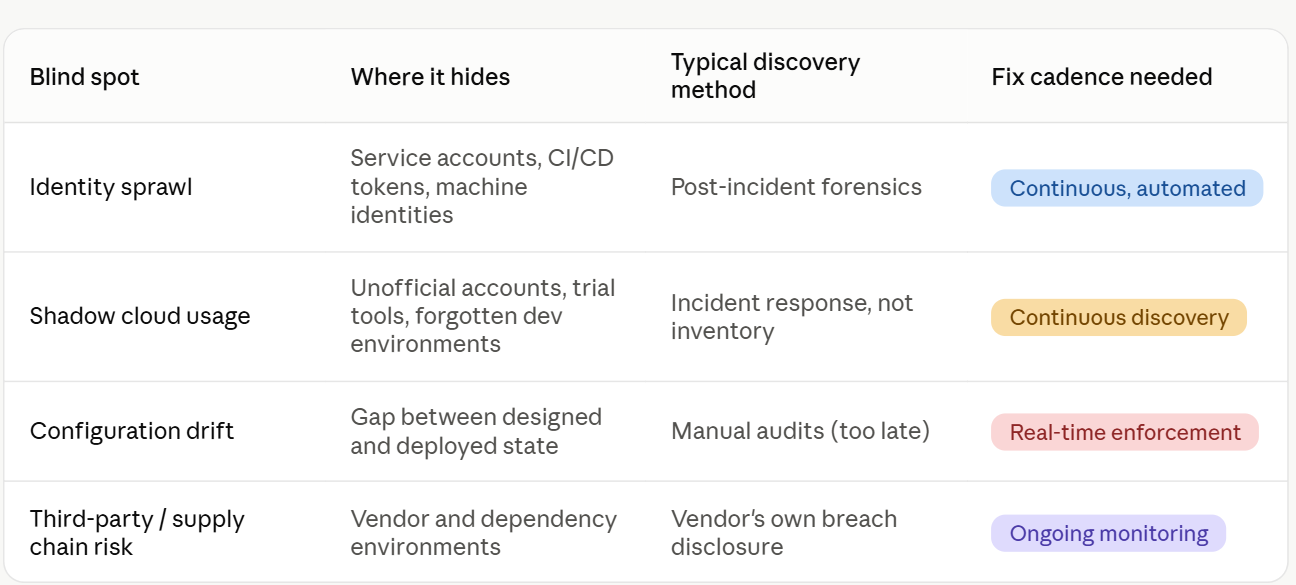
Most security teams think of identity in terms of users: who has access to what. But in a modern cloud environment, human users are often the minority. Service accounts, CI/CD pipelines, third-party SaaS integrations, and machine-to-machine credentials now outnumber people by a wide margin — and they tend to accumulate permissions far faster than anyone revokes them.
The blind spot isn't that these identities exist. It's that nobody in the organization is clearly accountable for their lifecycle. A developer spins up a service account to test an integration, it works, the project ships, and the account quietly keeps its permissions forever. Multiply that by every team, every sprint, every quarter, and you get an identity graph so tangled that even the security team can't answer a simple question: "if this credential were compromised right now, what could an attacker actually reach?"
Why it matters: Overprivileged non-human identities are one of the most common paths attackers use to move laterally once they get an initial foothold, precisely because defenders aren't watching them the way they watch human logins.
What closes the gap: Treat every identity — human or machine — as something with an owner, an expiration date, and a documented reason for its permissions. Least-privilege access reviews should include service accounts, not just people.
2. Shadow Cloud Usage Outside the Official Perimeter
Every organization has an "official" cloud footprint — the accounts, subscriptions, and projects that show up in the asset inventory. Fewer organizations have a clear picture of everything else: the marketing team's trial SaaS tool connected to customer data, the engineering team's personal cloud account used for a quick proof of concept, the forgotten dev environment from a project that got shelved two years ago.
This is shadow IT's cloud-native cousin, and it's arguably more dangerous, because cloud resources are so easy to spin up without any procurement process at all. A single API key or credit card is often all it takes. None of these resources appear in the CMDB. None of them get patched on a schedule. None of them are in scope for the next penetration test — because nobody officially knows they exist.
Why it matters: You cannot secure what you cannot see. Shadow cloud resources routinely become the entry point in incident post-mortems, discovered only after the fact.
What closes the gap: Continuous, automated discovery — not a quarterly spreadsheet exercise — combined with a lightweight, fast approval path for new cloud resources so teams aren't tempted to go around security just to move quickly.
3. Configuration Drift Between "Secure by Design" and "Secure in Practice"
Plenty of organizations do a genuinely good job of designing secure cloud architectures. The reference architecture is reviewed, the Terraform module is hardened, the golden image passes every check. Then reality intervenes: an engineer under deadline pressure manually adjusts a security group to unblock a deployment, a third-party vendor's setup script disables a control "temporarily," or an emergency change during an incident never gets reverted afterward.
Individually, each of these changes looks small and defensible. Collectively, they create a gap between the security posture leadership believes exists (based on the original design) and the posture that actually exists in production (based on what's really running). This drift is especially dangerous because it's invisible in architecture diagrams and design reviews — it only shows up if someone is actively comparing live configuration against policy, continuously.
Why it matters: Point-in-time audits catch drift that existed on audit day. They miss the drift that happens the week after, and the week after that.
What closes the gap: Policy-as-code enforcement that runs continuously rather than periodically, paired with alerting on any manual change that deviates from the approved baseline — so drift gets caught in hours, not at the next annual audit.
4. Third-Party and Supply Chain Risk Baked Into the Cloud Stack
Modern cloud applications are assembled, not built from scratch. A typical production environment leans on dozens of managed services, open-source packages, and third-party APIs, each with its own security posture that the organization has limited visibility into and even less control over. Security teams often focus intensely on their own infrastructure while treating these dependencies as a given — reviewed once at onboarding and rarely revisited.
That's a problem, because a vulnerability or misconfiguration in a vendor's environment can become an organization's incident just as easily as one in its own systems. Shared responsibility models make this explicit for cloud providers, but the same logic applies, often with far less scrutiny, to every SaaS tool and API-based dependency woven into the stack.
Why it matters: Attackers increasingly go after the weakest link in a supply chain rather than the hardest target directly, because compromising one vendor can open the door to many of that vendor's customers at once.
What closes the gap: Ongoing vendor risk monitoring rather than a one-time questionnaire, contractual requirements for security notifications, and architecture that limits the blast radius of any single third-party compromise.
The Four Blind Spots at a Glance
Closing the Gaps Starts with Visibility, Not More Tools
None of these four blind spots are exotic. They don't require a nation-state attacker or a novel zero-day to become a real problem — they exploit the ordinary friction of how cloud environments actually operate day to day. That's exactly why they persist: they're not failures of intention; they're failures of continuous visibility.
The organizations that manage cloud risk well aren't necessarily the ones with the biggest security budgets. They're the ones that have shifted from periodic checks to continuous verification — treating identity, inventory, configuration, and vendor risk as living things that need to be watched constantly, not boxes to be checked once a quarter.
If your last cloud security review didn't specifically address these four areas, that's a good place to start the next one.
Close Your Cloud Security Blind Spots
We help organizations assess cloud posture, identify hidden risks, and strengthen visibility across identity, configuration, assets, and vendor exposure.
Talk to CyberCube