When it comes to maintaining PCI DSS compliance, it is essential to highlight that companies dealing with cardholder data cannot disregard it, as it is part of the modern business world since companies are obliged to comply with the regulations by this standard in their partnerships. Due to the many acronyms and terminology of the standard, the average person easily gets lost and confused about its requirements. Our guide provides a detailed description of the twelve principles of PCI DSS v4.0.1.
Definition of PCI DSS
The Payment Card Industry Data Security Standard (PCI DSS) is rendered as a bunch of rules aimed at protecting cardholder data and developed by the PCI Security Standards Council — a body created by the major cardholders. All organizations processing any debit or credit cards need to comply with PCI DSS irrespective of their size and number of transactions.
The Significance of PCI DSS Compliance
Non-compliance is not merely a matter of not being compliant; it entails significant business problems.
- Penalties imposed by card companies averaging anywhere from $5,000 to $100,000 per month based on the type of merchant and violation.
- Higher transaction costs charged by acquiring banks to the merchants who are in violation of the rules.
- Inability to accept payment cards under serious instances of non-compliance.
- Damage to knowledge and awareness of the company which could be greater than the penalties involved.
- Liability resulting from leaking customer information due to carelessness.
Beyond avoiding penalties, PCI DSS compliance genuinely reduces your breach risk. The controls it mandates — encryption, access restrictions, monitoring and testing — address the most common attack paths used against payment systems.
The 12 Requirements of PCI DSS v4.0.1
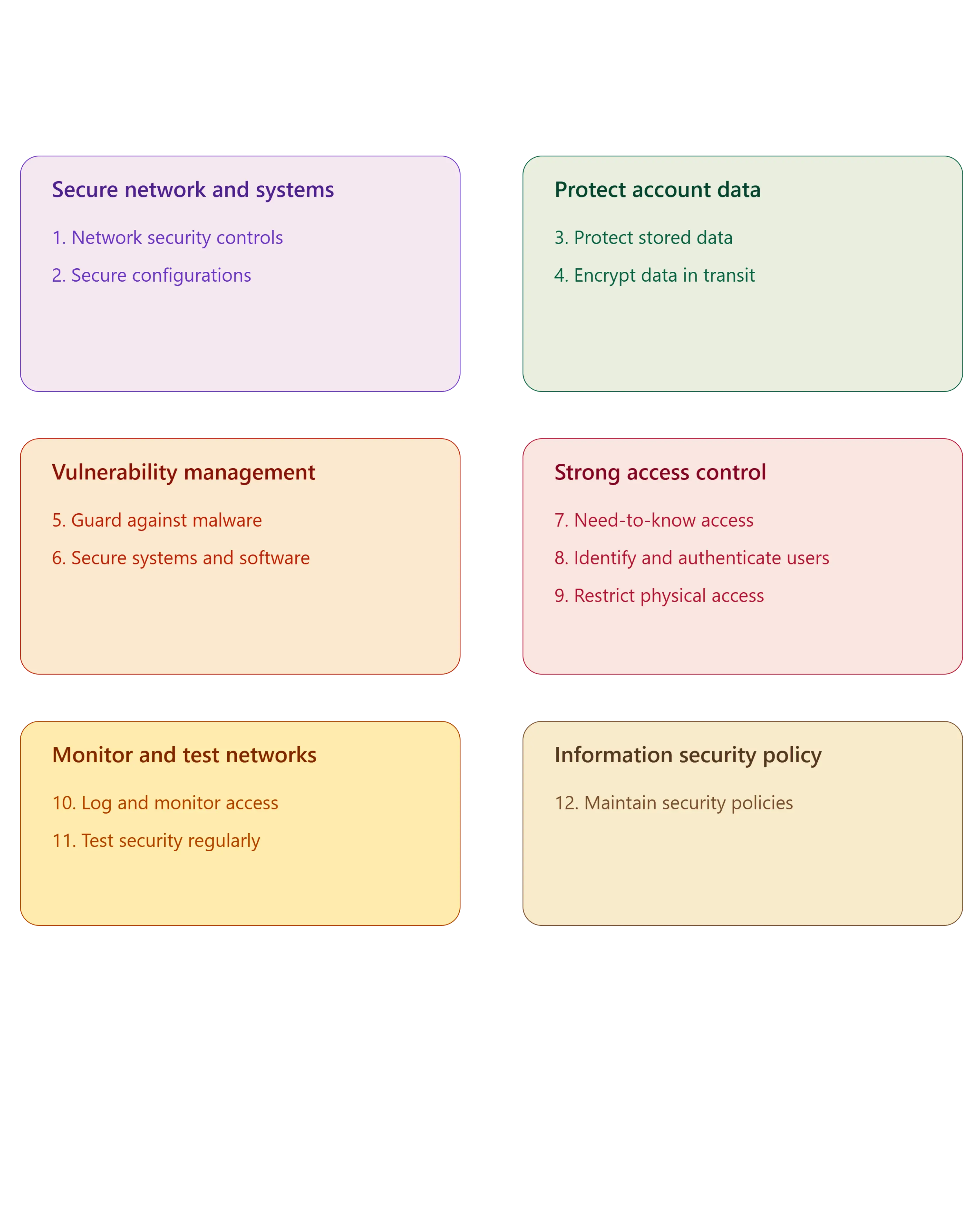
The standard is organized into six control objectives, each containing two or more specific requirements. Here's the full breakdown.
Six control objectives, twelve requirements — the full structure of PCI DSS v4.0.1.
Let's walk through each one in more detail.
Requirement 1: Install and Maintain Network Security Controls
This covers firewalls and network segmentation. Among the earliest mandates in this section, we have the clear obligation to document and establish rules governing the traffic between trusted and untrusted networks, maintain current configurations, and regularly evaluate the firewall rule sets. v4.0.1 this variant extends the definition of a firewall into the more general idea of network security controls, therefore including also cloud-native devices such as security groups and cloud NSC.
Requirement 2. Enforce Secure Configuration
Set passwords, superfluous features, and factory-setting configurations are excellent sources of exposure. This requirement indicates that the vendor default settings are to be altered, unnecessary features are to be turned off, and the configurations needs to be shaken for every system component reaching the network.
Requirement 3. Securing Stored Account Data
You should not store cardholder data if there is no need to do so. Where storage is indeed necessary, this requirement requires proper encryption, truncation, tokenization, or hashing, in addition to exact policies on retention and disposal. v4.0.1 gives additional recommendations on how to protect the PAN specifically.
Requirement 4: Protect Cardholder Data in Transit
Data moving across open, public networks must be encrypted using strong cryptography (think TLS 1.2 or higher). This requirement also now explicitly covers protecting PAN when using end-user messaging technologies.
Requirement 5: Protect Against Malicious Software
Anti-malware mechanisms must be deployed on applicable systems and kept updated. v4.0.1 expands this beyond traditional antivirus to account for evolving threats, including phishing-related malware delivery.
Requirement 6: Develop and Maintain Secure Systems and Software
This covers secure coding practices, patch management, and change control. A major v4.0.1 addition here is the requirement to manage payment page scripts on e-commerce sites — directly targeting
Requirement 7: Restrict Access by Business Need to Know
Access to cardholder data should be limited strictly to individuals whose job requires it. This means role-based access control, documented access policies, and periodic access reviews.
Requirement 8: Identify and Authenticate Access
Every user needs a unique ID — shared logins are not acceptable. v4.0.1 raises the bar significantly here: multi-factor authentication (MFA) is now required for all access into the cardholder data environment, not just remote or administrative access, and password requirements have been strengthened.
Requirement 9: Restrict Physical Access
Physical security controls — badge access, visitor logs, camera monitoring, and secure media handling — protect against in-person tampering or theft of systems and paper records containing cardholder data.
Requirement 10: Log and Monitor All Access
Detailed audit logs let you detect and investigate suspicious activity. Logs must capture user actions, system events, and access to cardholder data, and must be reviewed regularly. v4.0.1 introduces requirements for automated log review mechanisms in many environments.
Requirement 11: Test Security Regularly
This includes vulnerability scanning, penetration testing, and intrusion detection. Notably, v4.0.1 requires authenticated internal vulnerability scanning and formalizes penetration testing methodology requirements, including segmentation testing for service providers.
Requirement 12: Maintain an Information Security Policy
Documentation ties everything together. This requirement covers a formal information security policy, a risk assessment process, incident response planning, security awareness training, and third-party service provider management.
What Changed from PCI DSS v3.2.1 to v4.0.1
If you're migrating from the older standard, here are the highlights:
- MFA is now mandatory for all access into the cardholder data environment, not just administrative or remote access.
- Customized implementation is now an option for many requirements, allowing organizations to meet the intent of a control through alternative, validated methods rather than the exact prescribed approach.
- Targeted risk analyses are required for certain requirements, giving organizations flexibility to define frequency of specific activities based on their own risk assessment.
- E-commerce and payment page security get much more explicit attention, addressing the rise in skimming attacks.
- Password requirements have been strengthened, with a minimum length increase from 7 to 12 characters.
Many new requirements were introduced as "future-dated," becoming mandatory only after March 31, 2025 — giving organizations time to implement them.
Who Needs to Comply?
PCI DSS applies to any merchant or service provider that accepts card payments, regardless of size. Requirements scale by merchant level (based on annual transaction volume), which determines whether you need a formal Report on Compliance (ROC) from a Qualified Security Assessor (QSA) or can self-certify with a Self-Assessment Questionnaire (SAQ).
Practical Steps to Start Your Compliance Journey
- Scope your cardholder data environment (CDE). Identify every system that stores, processes, or transmits card data, and everything connected to it.
- Reduce your scope where possible. Tokenization and outsourcing payment processing to a validated third party can significantly shrink your compliance burden.
- Conduct a gap assessment against the 12 requirements to identify where you currently fall short.
- Prioritize the future-dated requirements, especially MFA expansion and password policy updates, since deadlines have already passed for many organizations.
- Document everything. Policies, procedures, and evidence of testing are as important as the technical controls themselves.
- Engage a QSA early if you're a Level 1 merchant or service provider, since remediation timelines can be longer than expected.
PCI DSS v4.0.1 isn't just a compliance checkbox — it reflects lessons learned from years of real-world breaches. The added emphasis on MFA, e-commerce security, and continuous monitoring reflects how attackers operate today. Treating the 12 requirements as an ongoing security program, rather than a once-a-year audit scramble, is the difference between organizations that stay compliant and those that keep failing assessments.
FAQs
1. Is it compulsory by law to comply with PCI DSS?
PCI DSS is not a law, but rather a contractual obligation imposed on companies by payment processing networks. Failure to comply may result either in fines or in an increase in fees associated with processing.
2. How often do I need to undergo the validation of PCI DSS compliance?
Most companies have to validate their eligibility every year either by completing a self-assessment questionnaire or by a formal audit by a Qualified Security Assessor.
3. Does using a third-party payment processor get rid of compliance?
Although it does not help you to wipe out the tasks that you need to perform to ensure compliance, it makes your requirements significantly narrower as well as shifts the responsibility of making sure that your provider is PCI compliant onto you.
Strengthen Your PCI DSS Compliance Program with CyberCube
CyberCube helps organizations assess PCI DSS gaps, validate controls, improve cardholder data security, and prepare for PCI DSS v4.0.1 compliance requirements.