Four acronyms, four completely different ways of finding (or stopping) vulnerabilities. Here's what each one does, where it fits in your pipeline, and how to combine them without wasting budget on overlap.
Quick reference
- SAST — scans source code, no execution needed. Runs in CI, catches bugs before merge.
- DAST — attacks a running app from the outside. Runs in staging, no code access needed.
- IAST — instruments the app during QA testing. Runtime context + exact code location.
- RASP — lives inside production and blocks attacks live. Not discovery, mitigation.
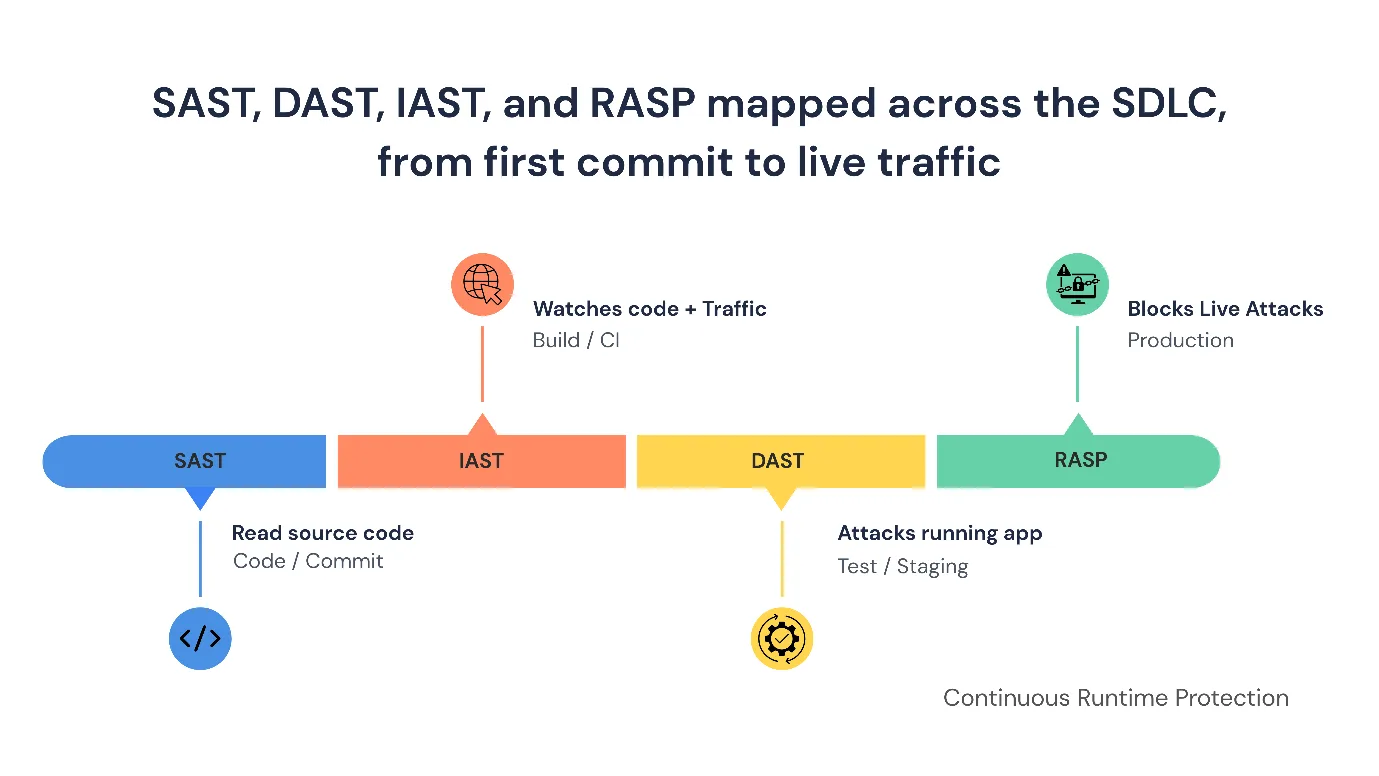
Before getting into definitions, it helps to see where each technique actually sits in the development lifecycle. The four aren't competing options; they're sequential layers, each picking up where the previous one's blind spot begins.
SAST: catching bugs before they compile
Static Application Security Testing
SAST examines source code, bytecode, or binaries without ever running the application. Think of it as an extremely meticulous code reviewer who never gets tired and has memorized every known vulnerable pattern, from unsafe string concatenation in a SQL query to insecure deserialization calls. Because it works on code at rest, SAST plugs directly into the IDE and the CI pipeline, flagging issues the moment a developer commits, often before the code is even merged.
The upside is speed and cost. A bug caught in a pull request costs a fraction of what the same bug costs once it reaches staging, and almost nothing compared to a production incident. The downside is that SAST has no idea how the application actually behaves once it's compiled and running. It can't see runtime configuration, third-party responses, or how components interact under real traffic — which is why it tends to produce a long tail of false positives that developers eventually learn to ignore.
DAST: attacking your own app like a hacker would
Dynamic Application Security Testing
DAST flips the approach entirely. Instead of reading code, it attacks a running application from the outside, the way a real attacker would: sending malformed inputs, probing endpoints, fuzzing parameters, and watching how the app responds. It needs no access to source code at all, which makes it language-agnostic and genuinely useful for testing third-party or legacy applications you don't own the codebase for.
Because DAST tests the real, deployed behavior of an application — its web server, its APIs, its misconfigurations — it catches issues SAST structurally cannot: broken authentication, exposed debug endpoints, and vulnerabilities that only appear once multiple components interact. The trade-off is timing. DAST needs a running environment, so it typically kicks in later, against a staging build, which means bugs surface later and cost more to fix. It also can't point to an exact line of code, just a URL and a symptom, leaving developers to trace the root cause by hand.
IAST: the hybrid that watches from the inside
Interactive Application Security Testing
IAST sits deliberately in the middle. It instruments the application with an agent that runs alongside it, usually during QA or automated testing, observing code execution from the inside while the app is exercised by real or scripted traffic. It gets the runtime context of DAST — actual data flow, actual execution paths — combined with the code-level visibility of SAST.
That combination is what makes IAST attractive: far fewer false positives than SAST, and unlike DAST, it can point straight to the vulnerable line of code because it's watching that code execute in real time. The catch is that IAST is only as good as your test coverage. It only sees the paths that actually get exercised during testing, so a sparse test suite means real blind spots. It also adds instrumentation overhead, which is acceptable in QA but not something most teams want running in production.
RASP: the bodyguard that ships with your app
Runtime Application Self-Protection
RASP is the odd one out on this list, because it isn't really a testing tool. It runs inside the production application itself, monitoring behavior in real time and actively blocking attacks as they happen — SQL injection attempts, unusual API call patterns, known exploit payloads — without waiting on a human or a patch cycle.
Think of SAST, DAST, and IAST as ways to find and fix vulnerabilities before release, and RASP as the safety net for whatever got through anyway, whether that's an unknown zero-day or a fix that simply hasn't shipped yet. That makes it genuinely valuable for virtual patching and cutting dwell time on live threats. But it's a mitigation layer, not a discovery layer — it won't tell your developers where the bug lives in the codebase, and if it's tuned too aggressively, it can add latency or block legitimate traffic.
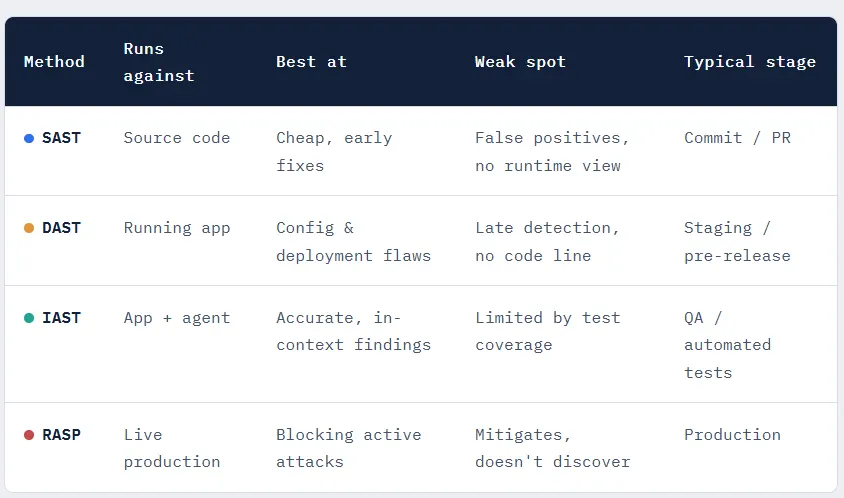
Side-by-side score card
So, which one should you use?
The real question isn't "which one," it's "which ones, in what order, given our constraints." A five-person startup shipping an MVP is starting from a very different place than a bank running a decade of legacy Java services.
If you're early-stage and resource-constrained, start with SAST. It's the cheapest to adopt, drops into a CI pipeline in an afternoon, and catches the most common coding mistakes before they ever reach a reviewer. Layer in DAST once you have a real staging environment worth attacking — it's your best defense against configuration and deployment issues that static analysis simply cannot see.
Once your team has real automated test coverage and a QA process mature enough to exercise meaningful code paths, IAST earns its keep by cutting the noise SAST tends to generate and handing developers line-level, actionable findings. RASP makes the most sense once you're running production workloads with real user traffic and can't afford a multi-week patch-test-deploy cycle for every critical finding — financial services, healthcare, and anything handling regulated data are the classic candidates.
The teams that get burned usually aren't missing one of these tools. They're the ones treating whichever tool they adopted first as the entire strategy.
Building a layered pipeline, not an either/or
In practice, mature AppSec programs don't choose between these four — they sequence them. SAST runs on every commit and pull request, catching issues at the cheapest possible point in the lifecycle. DAST runs against staging before every release, validating the deployed environment rather than just the code. IAST runs continuously during QA cycles, feeding off the automated test suite the team is already maintaining for functional testing. RASP sits in production as the final layer, catching whatever slipped through the first three and buying time to patch properly instead of scrambling.
None of this needs to happen at once. Most teams build it roughly in that order, adding a layer as the application, the team, and the risk tolerance grow. What matters is treating application security testing as a pipeline with checkpoints, not a single gate you pass through once and forget.
FAQs
1. Can I just use one of these instead of all four?
You can, but you'll have a structural blind spot. SAST alone misses runtime and config issues; DAST alone misses issues in code paths it never happens to exercise. Most security-mature teams run at least SAST and DAST together, then add IAST and RASP as the program matures.
2. Is RASP a replacement for a WAF?
No. A web application firewall filters traffic at the network edge based on known signatures; RASP sits inside the application and has visibility into actual code execution, which lets it catch attacks a WAF would miss. Many teams run both.
3. Which one should a small team adopt first?
SAST, almost always. It's the lowest-effort integration, works from day one in CI, and prevents the most common vulnerability classes before code ever ships.
Build the Right AppSec Testing Pipeline
We help teams assess application security maturity, choose the right mix of SAST, DAST, IAST, and RASP, and build a testing pipeline that reduces risk without slowing delivery.
Talk to CyberCube