If your company builds software that touches payment card data, you've probably heard the acronym PCI SSF thrown around in sales calls, RFPs, or security questionnaires. What's less obvious is what it actually takes to get there — how a vendor goes from an internal security review to having their product's name published on the PCI Security Standards Council's official list. This guide breaks that journey into five phases, using how real assessments unfold in practice.
What Is the PCI Software Security Framework (SSF)?
The PCI Software Security Framework replaced the older Payment Application Data Security Standard (PA-DSS), which had been in place since 2008. PA-DSS was built around a world of on-premise point-of-sale software; it didn't account well for cloud-hosted applications, mobile payment software, or continuous deployment. SSF was designed to be modular enough to cover all of it. It's worth noting SSF is a separate standard from PCI DSS — SSF governs how payment software itself is built and maintained, while PCI DSS governs how organizations handle cardholder data in their environments.
SSF currently consists of two independent standards, and a vendor can pursue either one or both:
- Secure Software Standard (SSS) — validates a specific version of a specific payment software product, similar in spirit to how PA-DSS validated individual applications.
- Secure Software Lifecycle Standard (Secure SLC) — validates the vendor's development organization itself: its governance, secure engineering practices, and change management processes, rather than one product release.
Both paths end the same way: a listing on the PCI SSC website. A Secure Software Standard validation adds your specific product to the list of Validated Payment Software. A Secure SLC validation adds your company to the list of Secure SLC Qualified Vendors, which also has a practical perk — once you're SLC-qualified, low-impact software changes can often be submitted directly to the PCI SSC without a full assessor review each time.
Why PCI SSF Certification Matters
Being listed isn't just a compliance checkbox. Acquirers, merchants, and enterprise procurement teams increasingly search the PCI SSC list before signing a contract with a payment software vendor. If you're not on it, you're often disqualified before the conversation even starts.
The 5 Phases of PCI SSF Certification
No two assessments look identical — scope, product architecture, and organizational maturity all shape the timeline — but nearly every successful certification passes through the same five stages.
Five phases, one path to PCI SSC listing.
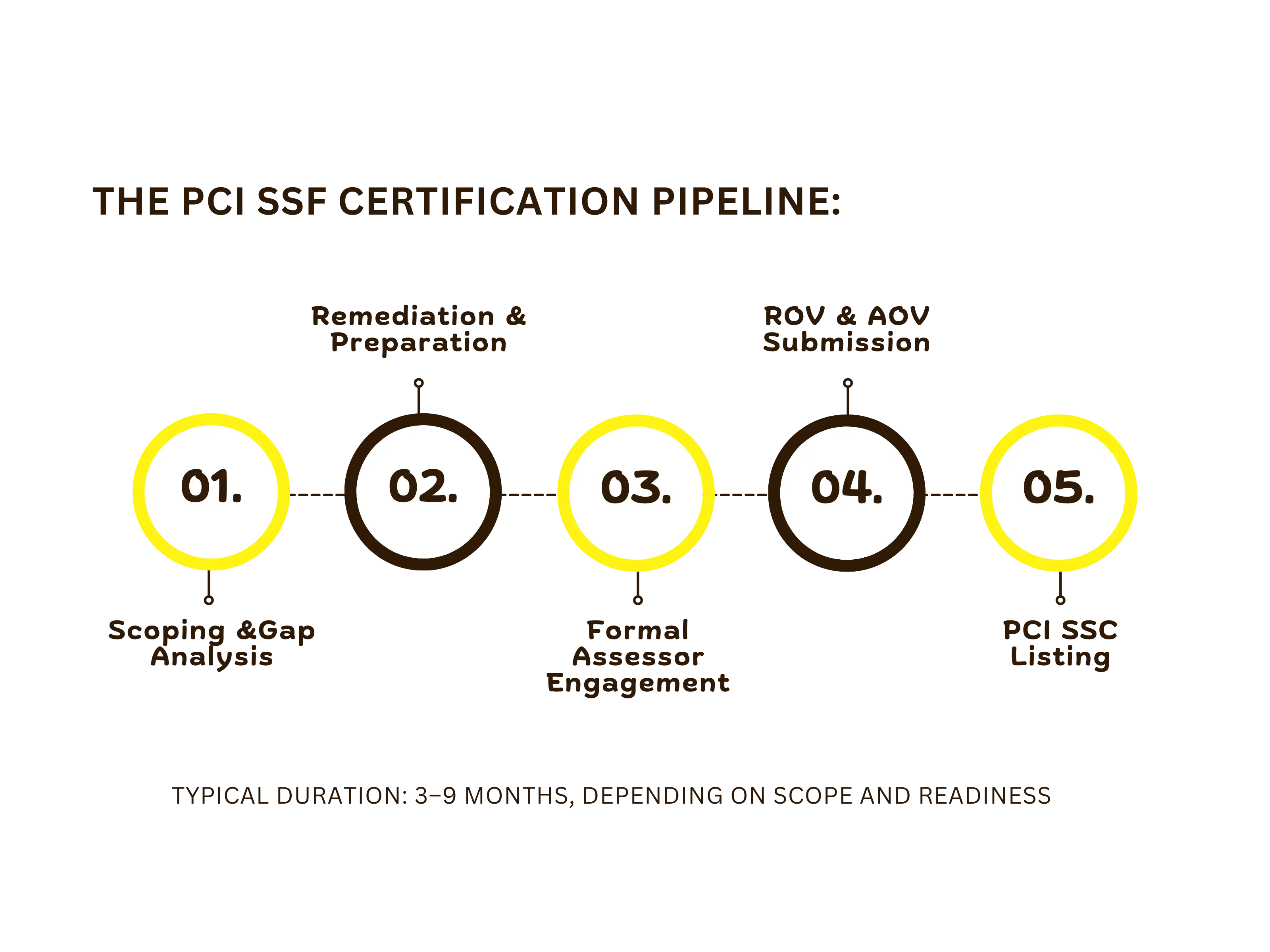
Let's walk through each phase in more detail.
Phase 1 — Scoping and Gap Analysis
Every engagement starts by defining exactly which product, version, and hosting environment falls under the assessment, then measuring current practices against the relevant control objectives. Most organizations bring in a qualified SSF Assessor Company or compliance advisor for this stage even though it's informal — the gap analysis isn't submitted to the PCI SSC, but it determines everything that follows. Skipping it, or doing it superficially, is the single biggest reason certification timelines blow out later.
During scoping, you'll also decide which standard fits your situation: Secure Software Standard for a specific product, Secure SLC for your development lifecycle, or both.
Phase 2 — Remediation and Preparation
With the gaps identified, the real work begins. This typically touches secure coding practices, cryptographic key handling, sensitive data protection in memory and logs, third-party component management, and for Secure SLC candidates — formal governance documentation. Many vendors run internal training or workshops with their assessor at this stage so that engineering teams understand exactly what evidence auditors will expect to see.
Phase 3 — Formal Assessor Engagement
This is the official assessment. A qualified Secure Software Assessor or Secure SLC Assessor — sourced from the PCI SSC's public list of SSF Assessor Companies — conducts hands-on testing. For the Secure Software Standard, that includes application-level penetration testing, memory dump analysis to check for exposed cardholder data, review of third-party module integrations, and forensic-style testing of how the software behaves after installation.
Phase 4 — Report on Validation and Attestation of Validation
Once testing wraps, the assessor documents every control objective and how it was met in a Report on Validation (ROV). Your organization then signs an Attestation of Validation (AOV), formally confirming the assessment's findings. Both documents are submitted to the PCI SSC for review.
Phase 5 — PCI SSC Listing
After the Council reviews and accepts the submission, your product or company appears on the public PCI SSC list — Validated Payment Software for Secure Software Standard, or Secure SLC Qualified Vendors for the lifecycle standard. From here, certification isn't a one-time event: maintaining your listing means ongoing monitoring, timely patching, and re-validation as your software or development practices evolve.
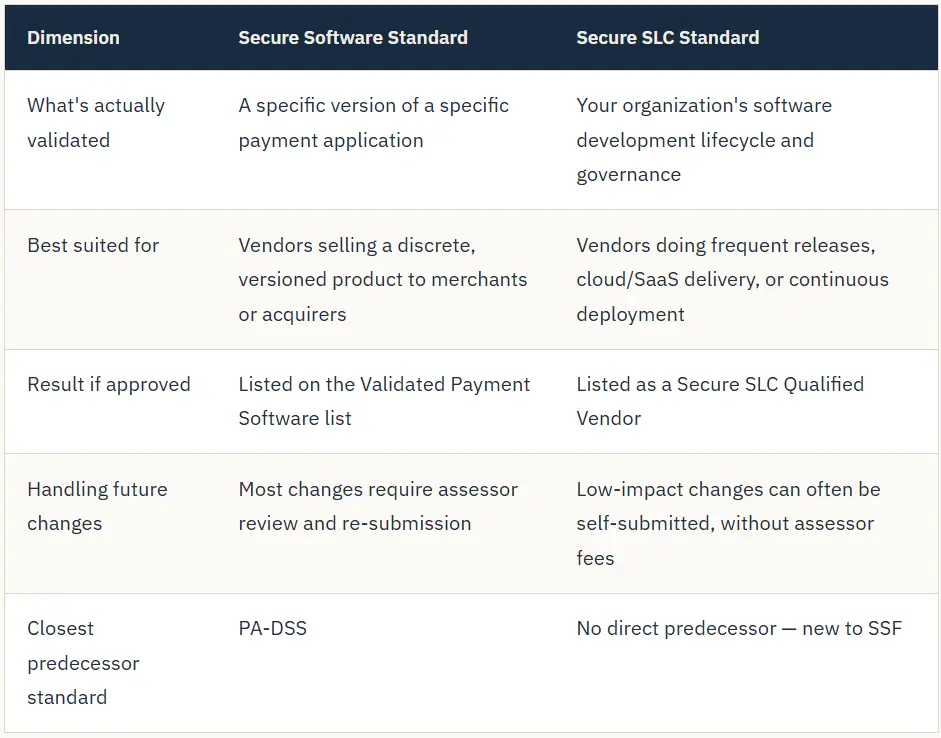
Secure Software Standard vs. Secure SLC: Which Do You Need?
It's common for vendors to assume these are two tiers of the same thing. They're not — they answer different questions, and many mature vendors eventually pursue both.
Common Pitfalls That Delay Certification
- Treating the gap analysis as a formality. Rushing through it means discovering real gaps mid-assessment, which resets timelines and budgets.
- Underestimating third-party dependencies. Assessors specifically look for how your software integrates with external libraries and services — undocumented third-party modules are a frequent finding.
- Weak secret management after installation. Leftover credentials, keys, or configuration artifacts from the install process are a recurring issue in Secure Software Standard testing.
- Choosing the wrong standard for your release model. A team shipping weekly builds will burn out trying to re-certify a single product version repeatedly under Secure Software Standard alone — Secure SLC exists precisely for this pattern.
FAQs
1. How long does PCI SSF certification take?
Most organizations move through all five phases in three to nine months. The biggest variable isn't the formal assessment itself — it's how much remediation work surfaces during the gap analysis.
2. Who is qualified to perform a PCI SSF assessment?
Only assessors from PCI SSC's published list of SSF Assessor Companies can conduct the formal assessment. Many are existing QSA companies that have added Secure Software or Secure SLC assessor qualifications.
3. Does PCI SSF certification expire?
Yes. Listings require ongoing maintenance and periodic re-validation as software versions and development practices change — it isn't a one-time badge.
4. Can a small vendor pursue Secure SLC without huge overhead?
Yes, though it requires genuine investment in documented governance and secure engineering practice — there's no shortcut version of the standard for smaller teams.
Get Ready for PCI SSF Certification with CyberCube
CyberCube helps software vendors run gap analyses, close remediation items, and coordinate with qualified assessors to reach PCI SSC listing.