If you run an e-commerce startup, there’s one reality you just can’t escape: As soon as you start accepting card payments, PCI DSS applies to you.
Whether you are a 2-person startup scaling quickly or an enterprise level merchant, if your systems store, process or transmit cardholder data, you are in scope.
And yet, most startups consider PCI DSS as something to “figure out later”.
That won't last.
A client asks, sooner or later. A payment provider asks or even worse, something breaks and your security posture wasn't ready.
The blog is not about theory but a practical road map to help e-commerce startups understand, approach and implement PCI DSS without over complicating it.
So, first thing’s first,
Want a PCI DSS roadmap for your payment flow?
We help you reduce card data exposure, choose the right SAQ, and build controls that won’t drift after the audit.
What is PCI DSS (And Why It’s More Important Than You Think)
PCI DSS (Payment Card Industry Data Security Standard) is a worldwide security standard developed to safeguard cardholder data. It is not a law, but a business requirement enforced by card networks (Visa, Mastercard, etc.) through your acquiring bank.
This has real consequences for startups:
- Noncompliance can result in fines and penalties.
- You may lose the ability to process payments.
- Enterprise customers may not want to do business with you.
Above all, PCI DSS isn’t simply about compliance – it’s about preventing needless security failures.
Biggest Myth: “We’re Too Small to Comply with PCI DSS”
This is where many startups go wrong.
For PCI DSS:
There is no minimum size threshold, even if you don't store card holder data directly, it still applies. And it still applies when using third party payment gateways (to a degree).
Smaller businesses, in fact, are often more exposed because:
- Security processes are not formal.
- Infrastructure is rapidly changing and reactive compliance is not planned.
A Beginner’s Guide to PCI DSS Compliance
Don’t think of PCI DSS as a to-do list, think of it as a roadmap. Here’s a simplified roadmap designed for e-commerce startups:
Step 1: Organize your payment flow
What did you do? Where does card data touch your business?
Are there any Payment pages, APIs and Back End Systems or are you a Third-party Service Provider?
You can’t protect what you don’t know.
This step establishes your Cardholder Data Environment (CDE), the basis for everything that follows.
Step 2: Figure Out Your PCI Level & SAQ Type
Your compliance requirements will depend on your transaction volume and architecture.
Like this:
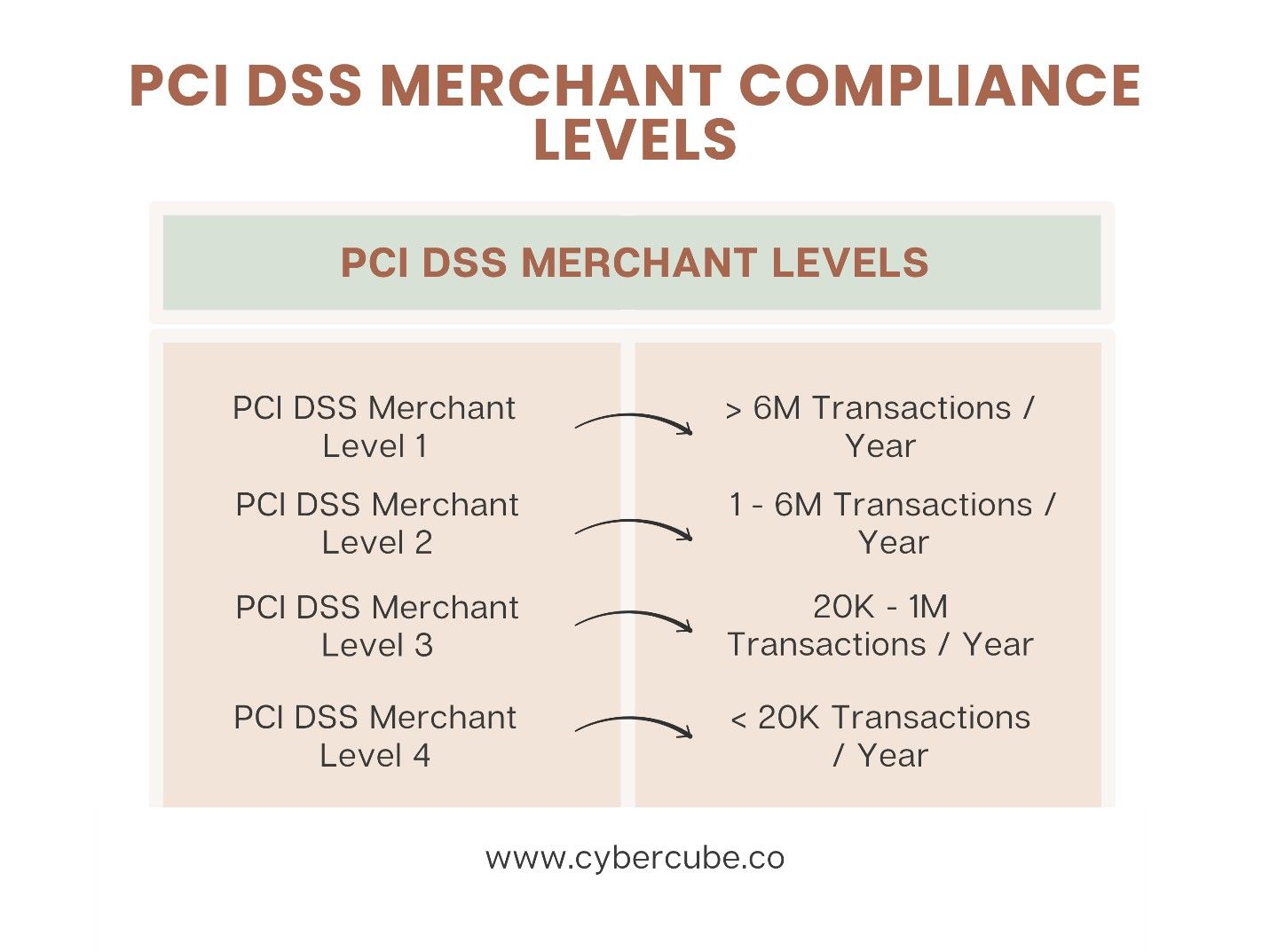
The most common SAQs for e-commerce startups are:
- SAQ A → completely outsourced payments (easiest)
- SAQ A-EP→ You host payment pages
- SAQ D → Complicated environments
The right SAQ is critical – your work load depends on it.
Step 3: Get Specific (The Best Thing You Can Do)
This is where startups can save time and money.
Best practice:
- Use PCI Compliant Payment Gateways
- Do not retain card data
- Tokenization or redirect-based payment flows
Compliance gets easier the less you have to deal with card data.
Step 4: Conduct a Gap Assessment
Before you put controls in place, assess your current state:
- What security controls are in place today?
- Who can see sensitive data?
- Are the systems patched and monitored?
This allows you to identify gaps against the 12 PCI DSS requirements.
Step 5: Apply Foundational Security Controls
PCI DSS has 12 requirements based on these areas:
- Network security (segmentation, firewalls)
- Data protection (encryption, data masking)
- Access control (minimum privilege)
- Monitoring & Logging
- Vulnerability testing (scans, penetration tests)
Startups should focus on:
- Payment pages
- Limiting access to the system
- Enabling log and monitoring
- Keeping systems up-to-date
Step 6: SAQ or Audit – Validation Completion
Once the controls are in place:
- Complete Your Assessment
- Conduct vulnerability scans (if necessary)
- Submit Attestation of Compliance (AoC)
Here is your certificate of compliance.
Step 7: Moving from One-Time Compliance to Continuous Compliance
This is the failing of many firms.
PCI DSS v4.0.1 moves the focus to:
- Ongoing surveillance
- Evidence collection ongoing
- Continuous security validation
Compliance is not something that happens once a year, it is a continuous process.
Even with a roadmap, expect challenges:
1. Scope underestimated
Many startups mistakenly think that a payment gateway takes them off the hook—but it doesn’t, it just takes them less on the hook.
2. PCI DSS is a checklist
Focusing on “passing the Assessment or SAQ” leads to bad security practices.
3. Not respecting current compliance
Without monitoring and ownership, security controls will degrade over time.
4. No Ownership
Without an owner, compliance becomes piecemeal and reactive.
How to Start an E-Commerce Business the Right Way
Instead of trying to "do everything", focus on:
✔ Design for Compliance Early
Better to do it right the first time.
✔ Reduce data exposure
Outsource payment processing where possible.
✔ Automate Where You Can
Utilize monitoring, logging and evidence gathering tools.
✔ Business Objective Alignment with Security
PCI DSS is more than just security, it impacts: Customer trust and Sales cycles
So, what is success in PCI DSS? What does it mean?
For an e-commerce startup, PCI DSS success does not equal:
- Audit passed
- How to Answer a SAQ
- Boxing for the compliance
It's:
- Complete visibility into how your payment data moves
- Minimizing exposure of sensitive data
- Secure practices that are consistent and reliable
The Bottom Line
Quite often PCI DSS is seen as a burden for startups.
But essentially, it’s a systematic way of building trust, managing risk and scaling responsibly.
Startups that view PCI DSS as:
late-stage requirement → struggle
A one-off task → Fail
A strategic foundation → faster growth
Because in e-commerce, security is more than just infrastructure.
It's part of your product."
Build PCI DSS Compliance the Right Way
Reduce scope early, automate where possible, and move from one-time compliance to continuous compliance.
Talk to CyberCube