You passed the audit. The reports look great, and for a moment, everything just feels right.
That last stamp of approval feels like crossing a finish line. But passing the audit isn’t really the end. It’s actually when a new kind of risk quietly starts creeping in. There are not really any indicators to inform you of when compliance drift is occurring, but it is happening under the radar, and most people don’t even know it exists.
Now, we are going to discuss, after the excitement of an audit has faded, how compliance drift creeps in on all teams, including those who have the best of intentions; you must know why the age-old method of ‘pass the audit and move on’ is putting you at a greater security risk; finally, you need to develop habits for continued compliance to allow yourself to always be one step ahead of the threat throughout the year.
Want to stay compliant all year?
Move from audit snapshots to continuous compliance habits with monitoring, automation, and clear ownership.
What Is Compliance Drift, and Why Should You Care?
When auditors are in your firm, everyone is on their best behaviour.
So, What Exactly Is Compliance Drift—And Why Should You Care?
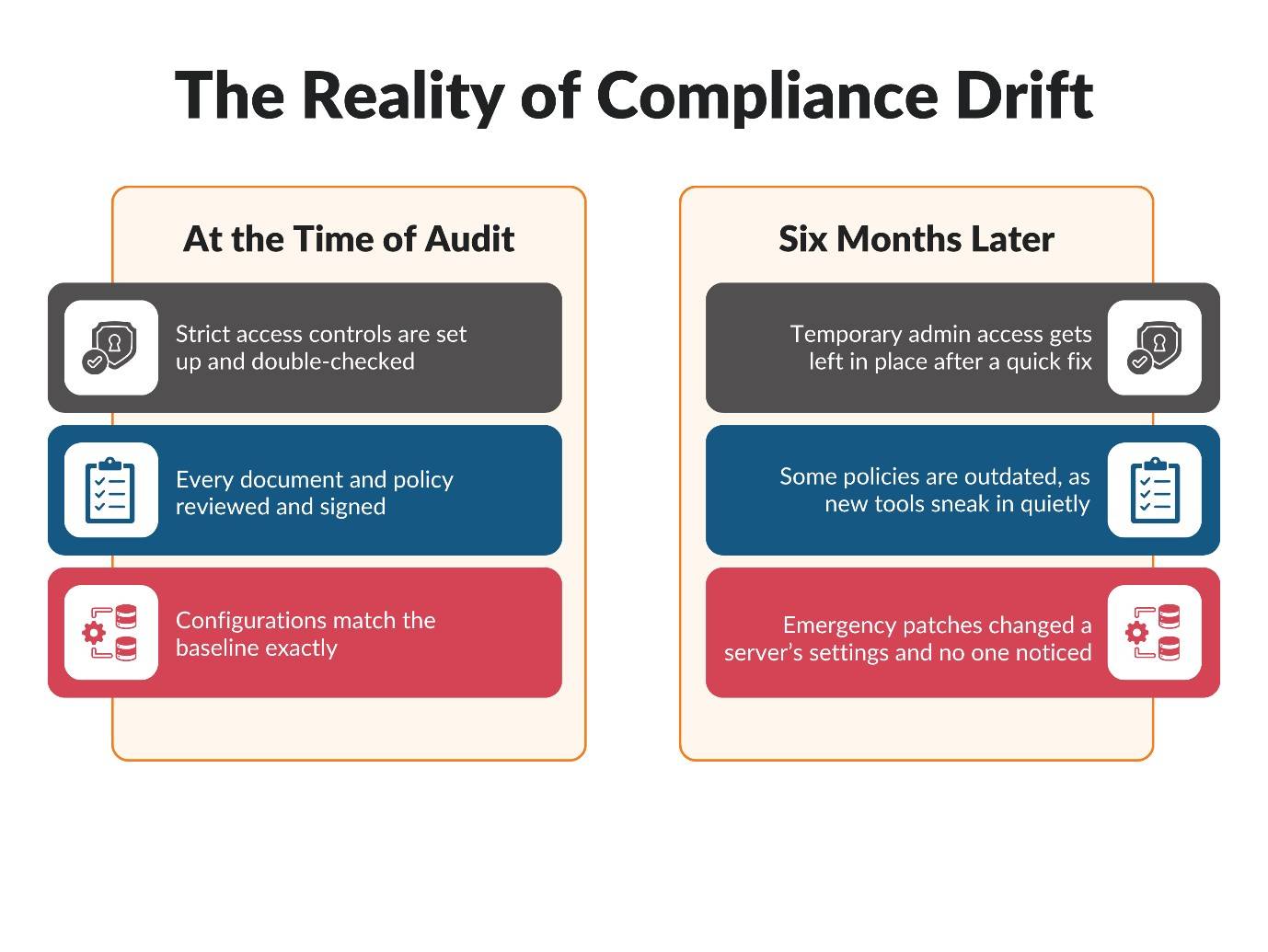
When the auditors are in, everyone’s on their best behavior. Controls get tested, evidence is double-checked, and every box is ticked—whether it’s PCI DSS, ISO 27001, SOC 2 or another framework. In that moment, your company truly is compliant.
Your infrastructure changes. Someone updates an app. Maybe a new hire needs access, or a teammate leaves, so permissions shift. All these little day-to-day tweaks seem totally harmless—just part of running a business, right? But over time, they quietly chip away at the solid security foundation you worked so hard to build.
Over time, those once-solid controls start to loosen. Maybe a server setting gets tweaked because of an urgent issue, or a quick workaround sticks around longer than planned. Before you know it—temporary fixes, special permissions, a config file updated on the fly start piling up. What was meant to be short-term quietly becomes the new normal and the ground starts shifting under your feet.
Why Does Compliance Drift Happen to Good Teams?
Compliance drift doesn’t happen because people don’t care or aren’t trying. In fact, the same folks who put in long hours to make sure your company passed the audit are usually the ones still keeping things running day to day. The real trouble starts after the auditors leave because business moves fast, and it’s easy for things to slip through the cracks while everyone is busy just getting the job done.
Why Real-Time Monitoring Slips Through the Cracks
In an Audit, everyone is paying attention Live to what is going on (verifying Controls, double verifying Settings, etc.) and making sure nothing is missed or falls through the cracks. Yet when the Audit is complete and the pressure is off, it's easy to lose that same level of vigilance. Most people will assume that things are working as they should, unless something clearly goes wrong. However, without the use of Constant, Real-time Monitoring, Small Issues can go unnoticed and can live silently in the background until they become Large Problems.
Today businesses are moving at a much faster rate than ever before; engineers are deploying new version updates almost every day, the IT team is constantly troubleshooting and fixing problems and the admins keep fine-tuning the setting to make sure that everything continues to work as expected. Security Controls often cannot keep up with this fast pace and are therefore more likely to fall behind due to all of the different individuals and teams being busy keeping everything working properly.
Who’s Really in Charge? How Unclear Ownership Let Things Slip
Sometimes, security controls end up living in a grey area. Take user access reviews, for example: is that the security team’s job? Does IT handle it? Or is it on the app owners? When everyone thinks it might be someone else’s responsibility, things slip by. Without clear ownership, accountability gets fuzzy, and those “little tasks” can quietly pile up until they become a real problem.
When Manual Tasks Rule the Day: Why Old Habits Are Hard to Break
A lot of companies still rely on old-school, manual routines—like quarterly spreadsheet marathons and collecting evidence by hand. Sure, these methods might get you across the finish line when the auditors come around, but they just aren’t built for the day-in, day-out challenges of staying secure. It’s like patching a leaky roof with duct tape; it works for now, but sooner or later, things are bound to slip through the cracks.
Why the Old Way of Doing Compliance Lets Us Down
At the heart of this problem is how we’ve always approached security. Most of us treat audits like a snapshot in time—a big checkmark proving everything was working when the camera flashed. But life keeps moving after the picture’s taken. An audit only confirms your controls on a single day; it doesn’t tell you what’s changed since.
While getting that certificate or audit report feels good, it doesn’t capture what’s really happening day to day. The evidence you collect—screenshots, config files, signed docs—it all just proves what things looked like in that one moment. Life keeps moving. The reality is, things can start changing the very next day, and those snapshots won’t tell you what’s shifting under the surface.
On top of that, most companies just don’t have an easy way to check—day in and day out, if those carefully built controls are still actually working. It’s no surprise, then, that compliance turns into a stressful scramble every few months instead of something your team can manage smoothly as part of normal business.
That’s where things get tricky—because there’s often a big difference between how things look on paper and what’s really happening behind the scenes. Your audit report might be spotless, but if you dig a little deeper, you might find your environment has quietly drifted into riskier territory without anyone noticing.
How Do You Keep From Slipping? Building Everyday Habits for Compliance
Fixing compliance drift isn’t about a fancy new tool or chasing another shiny badge. It’s about shifting how we think: seeing compliance not just as a box to tick off, but as something we nurture and check on, day after day.
- Keep an Eye Out with Real-Time Monitoring
- Let Automation Do the Heavy Lifting
- Make Sure Everyone Knows Their Piece of the Puzzle
- Make Compliance Part of Your Everyday Routine
Protecting Your Staff is a Daily Task
Auditing is an accomplishment, but that’s only the beginning of your security history—there will never be a final chapter to the story. Compliance decay can be insidious and progressive; slowly, over time, it reduces your defenses. The good news? If you recognize how and why it occurs, you can adapt your course. Setting up continual, daily practices will help you stay on top of things (like ongoing compliance evaluations and smart automation); therefore, you will not be surprised again and will continue strong throughout the year.
Don’t wait until the next audit to learn whether any controls have "slipped”; take a few minutes today and revisit your monitoring systems, ensure everyone understands what control they own, and implement compliance as a standard part of each day in your workplace.
FAQs
1. Compliance Drift in Cybersecurity
Compliance drift is a slow shift away from a "yes" compliant condition that occurs after the completion of an audit. As time passes, updates to IT systems (software/hardware), access control lists, basic configuration settings, etc., create a difference between the system that was approved (audited system) and the current system resulting in potential loss of security without an indication of concern.
2. What Causes Compliance Drift Post-Audit?
Compliance drift usually happens because of the reduced monitoring after the audit is completed, the rapid evolution of the IT environment, unclear guidelines as to who owns each control, and reliance upon manual processes to determine whether each control is working. While the organization continues to run its business, small changes can take place that, cumulatively, create a situation that breaches the original pass/fail rating of each control.
3. Why Does Continuous Compliance Matter to Security?
Continuous compliance helps to ensure that security controls remain effective over time. Organizations are able to identify when controls have drifted by evaluating them daily instead of only once/audit and this reduces the potential for exposure to risk while maintaining a consistent security posture within an ever-changing IT environment.
Don’t Wait Until the Next Audit
Take a few minutes today and revisit your monitoring systems, ensure everyone understands what control they own, and implement compliance as a standard part of each day in your workplace.
Talk to CyberCube