Talk to anyone who's been through a PCI PIN assessment more than once, and they'll tell you the actual control objectives — key management, dual control, secure device handling — usually aren't what causes the pain. The pain shows up earlier, in scoping, when an organization draws the boundary around its PIN environment either too narrow or too loose, and doesn't find out which until the assessor is already on-site.
Scoping sounds like a formality. It isn't. Get it wrong and you either leave a real gap in your PIN security posture, or you spend months preparing evidence for systems that were never actually in scope to begin with. Both outcomes are expensive in their own way.
Let’s walk through what actually falls inside a PCI PIN environment, where organizations most commonly miscount their boundaries, and how to scope the assessment properly before it starts.
What PCI PIN Actually Covers
The PCI PIN Security Requirements exist to protect one specific, high-value piece of data: the personal identification number a cardholder enters to authenticate a transaction. The standard governs how PINs and the cryptographic keys that protect them are created, transmitted, stored, and eventually retired, across both online and offline transactions at ATMs and point-of-sale terminals.
It's a different standard from PCI DSS, and worth keeping separate in your head. DSS protects cardholder data — account numbers, expiration dates, that kind of thing. It has nothing to say about PIN blocks specifically. PIN security requirements exist precisely because DSS doesn't cover that gap, and the two standards are validated independently, by different types of assessors, against different control objectives.
The requirements themselves are organized into seven control objectives covering roughly 30-plus individual requirements: secure PIN entry on approved devices, key generation, secure conveyance and loading of keys, key usage and separation, key administration, and the secure management of the equipment that touches any of this. If your organization is involved in acquiring, processing, storing, or transmitting PIN data — or if you run a key-injection facility or a certificate/registration authority supporting that process — you're a candidate for a PIN assessment.
The Scoping Workshop: Where It All Starts
Every properly run PCI PIN engagement begins with a scoping exercise, usually structured as a dedicated workshop between the organization and the assessor, before any testing begins. The goal is to map out, at minimum, which systems, facilities, and personnel touch PIN data or PIN-related keys anywhere in their lifecycle.
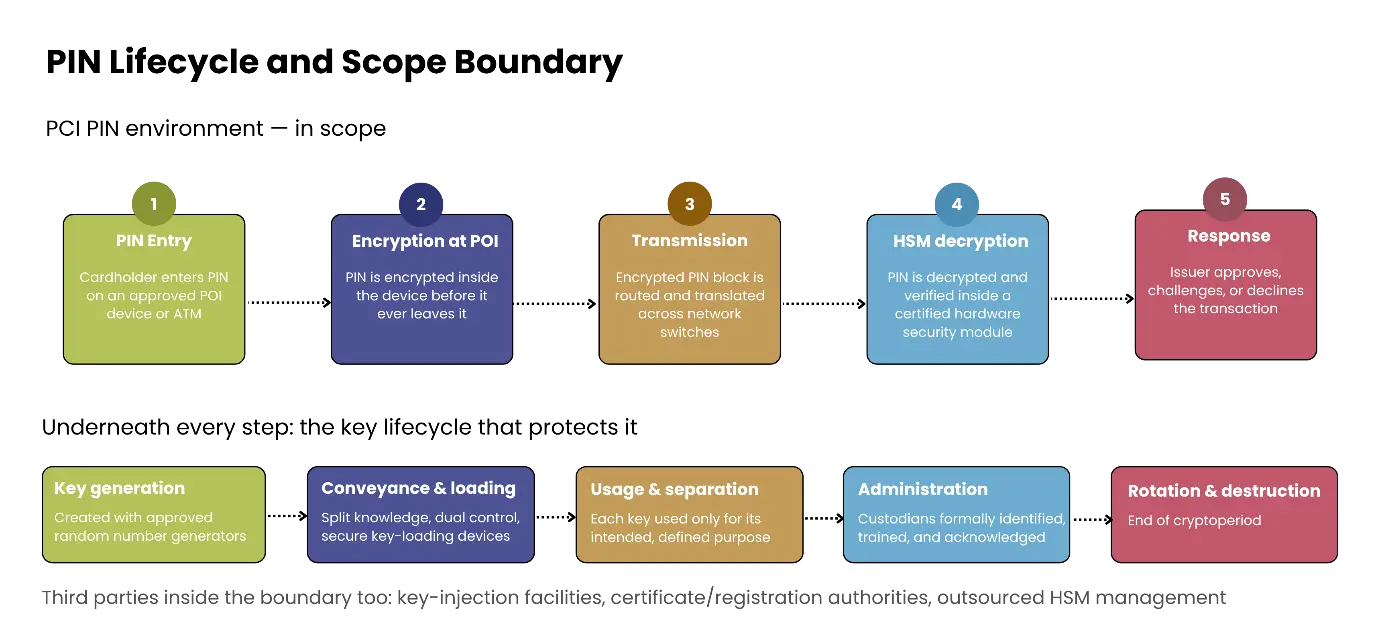
That "anywhere in their lifecycle" part is what trips people up. A PIN doesn't just exist for the split second it's typed into a terminal. It gets encrypted at the point of entry, translated between encryption zones as it moves through the payment chain, decrypted inside a hardware security module for verification, and the keys involved in all of that get generated, distributed, loaded, rotated, and eventually destroyed somewhere along the way. Scoping has to follow the PIN and the keys through every one of those stages, not just the parts of the process that feel most obviously "PIN-related."
Where Organizations Actually Go Wrong
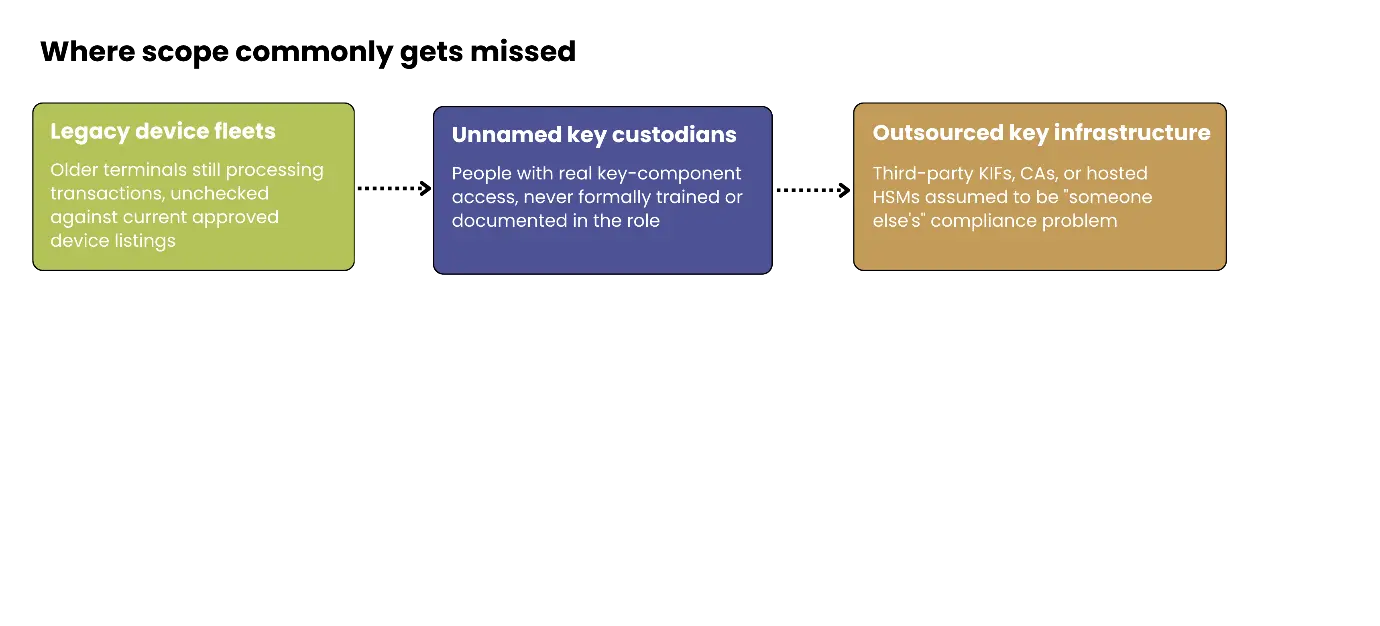
- Treating the POI device as the whole environment. It's an easy trap: the PIN pad is the most visible, most tangible part of the process, so it gets the most scoping attention. But the moment that encrypted PIN block leaves the terminal, it travels through switches, gets translated inside HSMs, and touches key management infrastructure that's often managed by a completely different team, sometimes a different vendor entirely. Scoping that stops at the terminal leaves the rest of that chain unexamined.
- Underestimating who counts as a key custodian. PCI PIN requires designated key custodians who go through formal acknowledgment of their responsibilities, along with defined PIN-processing roles tied to payment network rules. Organizations frequently discover, mid-assessment, that people functioning as de facto key custodians — someone with access to key components as part of a broader IT or ops role — were never formally identified, trained, or documented as such. That's a scoping gap wearing a personnel-policy costume.
- Losing track of legacy and mixed device fleets. Retailers and acquirers running PIN acceptance across years of hardware refreshes often end up with mixed fleets: some devices on current-generation firmware, some legacy models that technically still process transactions. Every device model needs to be checked against current PCI-approved device listings, and unlisted or unsupported legacy hardware is a common source of last-minute scoping surprises.
- Missing third parties who touch the key lifecycle. Key-injection facilities, certificate and registration authorities, and outsourced HSM management are all activities that can sit entirely outside an organization's own walls, run by a vendor, and still be squarely inside PCI PIN scope. If a third party injects keys into your devices or operates infrastructure your keys pass through, that relationship needs to be scoped in, with clear documentation of who's responsible for which control objectives.
- Assuming dual control and split knowledge are "just policy." On paper, split knowledge and dual control for cryptographic key components are simple ideas — no single person should ever hold a complete key. In practice, these principles erode slowly. A key ceremony gets streamlined under time pressure. An exception gets made for a specific system during a migration. None of it looks like a violation in the moment, but assessors consistently find that these small, well-intentioned shortcuts are where key management controls actually break down over time.
- Not accounting for where PINs exist in clear text, even briefly. The standard is built around the principle that a PIN should never exist in clear text outside a certified, tamper-resistant security boundary. Scoping exercises sometimes miss transitional points in custom-built or older systems where this boundary isn't as airtight as everyone assumes — a debugging log, a legacy interface, a temporary buffer that nobody's looked at closely in years.
A Simple Way to Think About Scope
A useful mental model: if you can trace a PIN or a PIN-encryption key touching a system, a facility, or a person, that touchpoint is in scope until you can prove otherwise — not the other way around. Organizations that scope conservatively, then negotiate exclusions with evidence, tend to have a much smoother assessment than organizations that scope narrowly and get expanded mid-engagement.
The flow below shows how that trace typically runs, end to end.
Getting Through the Assessment
Once scope is agreed, the mechanics of a PCI PIN assessment follow a fairly consistent pattern. A Qualified PIN Assessor (QPA) — trained and certified by the PCI SSC specifically for this standard — conducts an onsite assessment involving interviews, document review, and technical testing against the applicable control objectives. For entities like key-injection facilities and certificate authorities, a self-assessment questionnaire may apply instead, depending on card brand requirements.
Assessments happen on a two-year cycle rather than annually, which is one of the more useful distinctions between PCI PIN and standards like PCI DSS or PCI 3DS. That said, two years is a long enough gap that scope tends to drift if nobody's actively maintaining it — new devices get deployed, vendors change, teams reorganize — so it's worth treating scope as something to revisit periodically rather than a document you write once and file away.
Why Getting Scope Right Matters More Than It Seems
A missed scoping boundary doesn't just risk an assessment finding. It risks the thing the entire standard exists to protect. PIN data sits at one of the most sensitive points in the payment chain, and a gap in scope is functionally a gap in your actual security posture, dressed up as a paperwork issue. Organizations that invest real time in the scoping workshop — mapping every system, facility, vendor, and role that touches PIN data or key material — consistently spend less time firefighting later, both during the assessment and in the two years between them.
FAQs
1. What's actually in scope for a PCI PIN assessment?
Any system, facility, or person that processes, transmits, stores, or manages PINs or PIN-encryption keys. That includes POI devices, HSMs, key-injection facilities, certificate and registration authorities, and the personnel who function as key custodians anywhere along that chain.
2. How is PCI PIN different from PCI DSS?
PCI DSS protects cardholder data like account numbers. It doesn't cover PIN blocks. PCI PIN exists specifically to close that gap, with its own control objectives focused on cryptographic key management and secure PIN handling, validated separately from a DSS assessment.
3. How often does a PCI PIN assessment happen?
Every two years, via an onsite assessment from a Qualified PIN Assessor, or a self-assessment questionnaire for certain third-party entities depending on card brand requirements.
Scope Your PCI PIN Environment Correctly
CyberCube helps organizations map PIN-processing systems, HSMs, key-management infrastructure, facilities, third parties, and key custodians before the PCI PIN assessment begins.