For years, organizations have relied on Vulnerability Assessment and Penetration Testing (VAPT) as their primary line of defense. Schedule the test. Receive the report. Fix what you can. Repeat next year.
But here’s the uncomfortable truth: that approach does not match the speed of modern cyber threats anymore.
Attackers do not wait for your annual test. They do not respect quarterly schedules. They scan, exploit, and automate constantly. And in 2026, that gap between periodic testing and continuous threat activity is exactly where breaches happen.
This is why forward-thinking security leaders are moving toward Continuous Vulnerability Management as a Service (VMaaS). Not because VAPT is useless, but because it is no longer enough on its own.
Let’s break down why.
Want a Continuous Vulnerability Roadmap?
We’ll help you design a VMaaS model aligned to your assets, threat exposure, and remediation workflows.
The Problem with Once-a-Year Security
Imagine servicing your car once a year but driving it every day in extreme weather. That is what annual VAPT looks like in today’s digital environment.
Your infrastructure changes daily:
- New code deployments
- Cloud configuration updates
- New integrations and APIs
- Employee onboarding and offboarding
- Patch cycles and version upgrades
The moment your VAPT report is delivered, your environment starts changing again. That report becomes outdated faster than most organizations realize.
Security Is No Longer Static
In 2026, businesses operate across:
- Hybrid cloud environments
- Remote work setups
- SaaS platforms
- Containers and microservices
- APIs and third-party integrations
Every change introduces potential risk. Modern attackers use automation to scan for vulnerabilities within hours of disclosure.
If you test in January and patch in February, what happens in March when a critical new exploit drops? That window of exposure is exactly what attackers look for.
Why VAPT Alone Falls Short Today
Let’s be clear: VAPT still has value. It simulates real-world attacks and provides deep insights. But here is where it struggles in 2026:
1) It’s a Snapshot, Not a Stream
VAPT shows what is vulnerable at a specific point in time. It does not show what becomes vulnerable tomorrow.
2) It Generates Long Reports — Not Continuous Action
Teams often receive reports listing hundreds or thousands of findings. Without real-time prioritization, the hardest question remains: What do we fix first?
3) It Doesn’t Adapt to Live Threat Intelligence
If exploit activity spikes for a vulnerability, traditional VAPT does not automatically re-prioritize it. Teams are left connecting the dots manually.
4) It Doesn’t Fit Modern DevOps Speed
Features ship weekly—sometimes daily. Security must move at the same pace. Periodic testing cannot keep up with continuous deployment.
VMaaS: Moving Security at Threat Speed with Continuous Vulnerability Management as a Service
Continuous VMaaS helps teams move from reactive to proactive security by continuously identifying vulnerability exposure in applications and infrastructure.
Instead of asking, “What was vulnerable last quarter?”, you are asking:
What’s vulnerable right now—and how urgent is it?
Here is what changes with VMaaS:
Real-Time Visibility
Your assets are continuously monitored. When new vulnerabilities appear, they are detected quickly—not after months.
Context-Driven Prioritization
Not all vulnerabilities are equal. A medium-risk flaw on a public-facing payment application may be more dangerous than a high-risk issue on an isolated internal system.
Continuous VMaaS factors in:
- Asset importance
- Exploit availability
- Threat activity trends
- Business impact
So teams focus on real risk—not just technical severity.
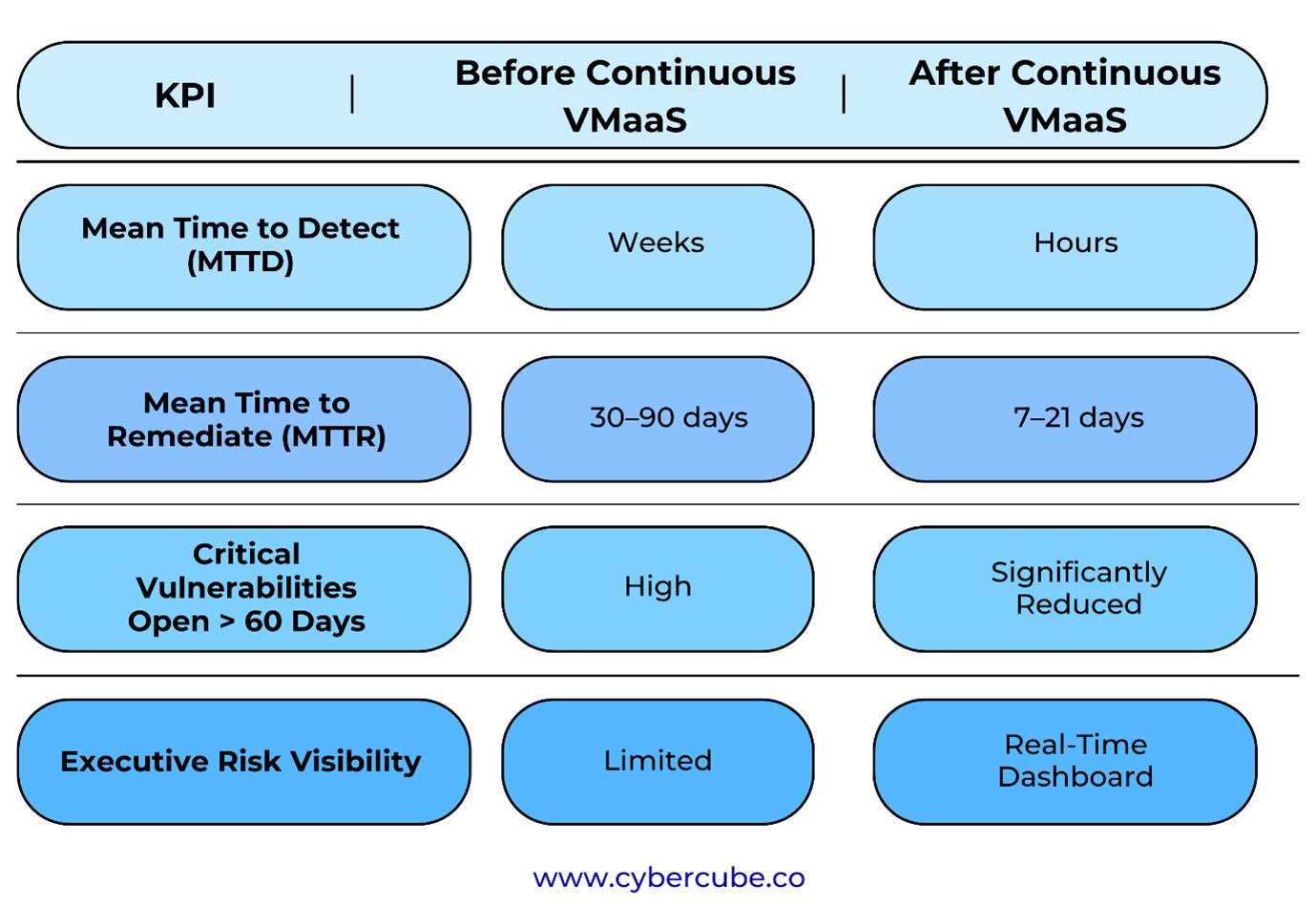
Faster Remediation Cycles
VMaaS integrates with ticketing systems and DevOps workflows. Vulnerabilities do not sit in reports; they become actionable tasks.
The result is shorter remediation timelines and less exposure.
Executive-Level Visibility
Boards and leadership teams want clarity—not 80-page technical documents.
Continuous VMaaS provides dashboards that show:
- Risk trends over time
- Reduction in critical vulnerabilities
- Remediation velocity
- Overall security posture maturity
Security becomes measurable—not abstract.
Cut Vulnerability Exposure Windows
We help implement continuous visibility + risk-led prioritization + workflow integration.
Why 2026 Demands Continuous Vulnerability Management
The threat landscape has fundamentally shifted. Attackers now use:
- Automated scanning bots
- Ransomware-as-a-service models
- AI-assisted reconnaissance
- Exploit marketplaces
The average time between vulnerability disclosure and exploitation has dramatically reduced.
If your testing happens once or twice a year, you are operating on yesterday’s timeline.
Continuous VMaaS aligns with today’s reality:
- Threats evolve daily
- Infrastructure changes constantly
- Compliance expectations are increasing
- Customers expect stronger security assurance
Organizations that adopt continuous models are not only more secure—they are more resilient.
Where We Fit In
Making the shift from periodic VAPT to continuous vulnerability management may sound complex, but it does not have to be.
We help organizations transition smoothly into a continuous VMaaS model designed for modern infrastructure:
Unified Visibility Across Environments
Whether you operate on-prem, in the cloud, or in hybrid environments, we provide centralized visibility across your digital assets—without blind spots or fragmented views.
Intelligent Risk Scoring
Instead of overwhelming teams with raw vulnerability lists, we apply intelligent risk prioritization — factoring in exploit trends, asset criticality and business impact.
This helps teams focus on what truly matters first.
Ongoing Threat Intelligence Integration
The threat environment changes every day. Therefore, we combine real-time intelligence feeds with your vulnerability priorities to ensure they change quickly. Whenever there is something that is actively being exploited in an environment and it is brought to your attention.
Uninterrupted Workflow Integration
Security should not occur in a vacuum. We provide integrations within existing workflows that will allow all three teams (DevOps, IT, and Security) to work together without disrupting production level activity.
Quantifiable Improvements in Risk Posture
Using dashboards and reporting capabilities will allow organisations to show management and stakeholders this has improved their risk posture over time (which is important to them).
The Business Case: It’s Not Just About Security
Continuous VMaaS is not only a cybersecurity upgrade. It is a business decision. Leaders invest because it delivers:
- Reduced breach probability: Shorter exposure windows reduce attack success.
- Stronger customer trust: Buyers evaluate vendor security maturity more than ever.
- Increased operational efficiency: Less time wasted on low-impact items.
- Improved decision-making: Risk trends enable better planning and budgeting.
A Practical Way to Start
If your organization relies on annual or bi-annual VAPT, you do not need to abandon it completely. Instead, evolve:
- Keep VAPT for deep-dive validation.
- Layer continuous VMaaS for real-time visibility.
- Integrate vulnerability management into daily workflows.
- Track measurable KPIs like time-to-remediation.
- Continuously refine based on threat trends.
In 2026, cybersecurity is about pace of change. Threat actors move faster, infrastructure changes rapidly, and innovation evolves quickly—therefore security must evolve as well.
While Vulnerability Assessment and Penetration Testing (VAPT) helps with vulnerability management; relying solely on these types of assessments (e.g., to perform periodic testing or 'a one-time lock on the door of your home') is not enough to protect your organization.
A smarter, more resilient way to address ongoing risk is through the continuous vulnerability management (CVM) model — CVM provides your organisation with the tools and real time intelligence required to keep your organisation ahead of the curve - not just responding when there are issues.
Security is not an isolated Project, but rather a continuous Commitment to protecting your workforce and clients by implementing a data driven Cybersecurity program -Understanding that you cannot identify risk without a comprehensive & well-designed cybersecurity risk management solution.
Frequently Asked Questions
1. VAPT vs Continuous VMaaS: What's the Difference?
VAPT is a periodic vulnerability assessment and penetration testing process that identifies vulnerabilities in an organization at a single point in time. Continuous VMaaS is a continuous monitoring service for vulnerabilities in real-time with the ability to prioritize and remediate vulnerabilities as they occur, providing organizations with an advantage in staying ahead of ever-changing threats.
2. Why isn't VAPT enough as of 2026?
According to the dates listed, cyber threats are evolving daily, and therefore, infrastructures are constantly changing. Because VAPT is performed as a snapshot in time, it does not enable organizations to keep pace with the speed of modern threats. Continuous VMaaS is a process that fills this gap by providing continued visibility into threats, along with real-time threat intelligence and improved remediation cycle times.
3. How does Continuous VMaaS enhance security operations?
Continuous VMaaS provides integration capabilities with existing operations and workflows, providing teams with real-time visibility into potential risks and easy identification of low-impact versus high-impact potential risk factors. As a result, teams will be able to enhance their operational efficiency through decreased time spent working on low-risk items.
Modernize Vulnerability Management for 2026
Move beyond periodic testing with continuous visibility, risk-driven prioritization, and remediation workflows aligned to how modern systems change.
Talk to CyberCube