
Here's something most compliance teams don't want to admit: by the time auditors show up, the result is often already baked in. Not because of what happens in the conference room during the review but because of what didn't happen in the months and years before it.
The real failures are quiet ones.
A policy that nobody refreshed after the regulation shifted.
An approval that got verbal sign-off but never made it into writing.
A procedure that one person knows by heart but never documented.
None of it feels urgent — until someone with a clipboard starts asking questions you can't answer.
The story your documentation tells is the only story that counts.
If your records can't show who did what, when, and under which policy, it doesn't matter how well your team actually performed.
Documentation Is the Part Everyone Underestimates
There's a common trap that even experienced compliance leaders fall into: they build solid controls, invest in training, and put real effort into getting operations right — then treat documentation as the administrative afterthought.
Something to tidy up later.
But auditors don't evaluate intent. They look at evidence.
If your records can't show who did what, when, and under which policy, it doesn't matter how well your team actually performed. The story your documentation tells is the only story that counts.
Think about what that means in practice.
Two organizations might run nearly identical compliance programs.
One has clean, traceable records.
The other has the same practices but patchy documentation.
In an audit, those two programs get treated very differently.
The gap isn't operational, it's on paper.
That's both the frustration and the opportunity here. Because unlike building an entirely new compliance framework, fixing documentation is largely a matter of discipline and the right systems.
Five Gaps That Show Up Again and Again
Over time, documentation failures tend to cluster around the same problems.
Recognizing them is the first step.
1. Nobody Actually Owns the Policy
Ask around in your next leadership meeting:
"Who's responsible for keeping this policy current?"
If the answer is vague, or if three people point to three different colleagues, you've got your first problem.
When ownership is fuzzy, nothing gets updated on time, reviews slip, and slowly — almost invisibly — a document drifts away from both the regulation it was meant to address and the way your team actually works.
Orphaned policies are one of the most consistent contributors to audit findings.
They're also one of the most preventable.
2. Version Control in Name Only
You'd be surprised how often this comes up.
An auditor asks what policy was in effect during a specific period.
Someone pulls up the file.
But it's been revised multiple times without a clean record of what changed or when.
If you can't reconstruct your policy history, you can't defend your decisions made under it.
A folder full of files named things like:
- Policy_Final.docx
- Policy_Final_REVISED.docx
- Policy_Final_v4b.docx
- Policy_Final_v4b_Updated.docx
...is not version control, It's version chaos.
3. Reviews That Happen Whenever (Which Means Rarely)
Policies need to be revisited on a schedule not just when something breaks or when an audit is coming.
When review workflows are informal, reviews get pushed, skipped, or done in a rushed, undocumented way.
What you're left with are policies that look active but are functionally outdated.
Auditors pay attention to when documents were last reviewed.
A three-year-old review date signals a program that isn't being managed.
4. Audit Trails with Holes in Them
Good documentation doesn't just capture what the policy says, it captures what happened and who was involved.
Questions auditors often ask include:
- Who approved this change?
- Who accessed that record?
- When was this exception granted?
- Who authorized it?
If your systems can't surface that information quickly, you're left asking auditors to take your word for it. They won't.
Gaps in audit trails convert otherwise defensible decisions into open questions.
And open questions become findings.
5. Policies That Nobody Retired
Outdated policies are quietly dangerous because they create a false sense of security.
The document exists, so it feels like coverage.
But it may reference regulations that have since changed or processes your team stopped using altogether.
That's a problem on two fronts:
- You might think you're covered when you're not.
- If you failed to follow an outdated policy, auditors can use that document as evidence of nonconformance.
Stale policies need to be actively retired, not just forgotten.
What Actually Happens in the Audit Room
Auditors are methodical, and they're trained to pull at loose threads.
What typically starts as a routine document request can quickly expand once a gap appears.
Say an examiner asks for evidence that a particular control was operating during Q3.
Your team provides a policy but the supporting records are thin.
The auditor asks who approved a specific exception.
Nobody can say definitively.
They ask for the previous version of that procedure.
It's not findable.
Each question without a clean answer signals something larger, and the scope of the review grows accordingly.
This is how a documentation gap becomes a much bigger problem.
It's not that auditors assume bad faith, it's that incomplete records make it impossible to establish good faith.
Getting Ahead of It: What You Can Do Before the Next Audit
None of this requires a wholesale transformation.
The organizations that do this well haven't necessarily built the most elaborate systems — they've just built consistent habits.
A few things make a significant difference.
Give Every Policy a Named Owner
One person should be accountable for:
- Keeping the document current
- Managing the review cycle
- Ensuring it reflects how work actually happens
Document that ownership explicitly, and update it when people move on.
-
Invest in Real Version Control
Move off shared drives with manual naming conventions.
Use a system that:
- Logs changes automatically
- Retains full history
- Timestamps approvals
The goal is simple: being able to pull up any past version of a policy in seconds, not after an afternoon of searching.
-
Create a Review Schedule and Stick to It
Decide how often each policy needs to be reviewed based on the risk it carries.
Then make sure every review is documented — even when nothing changes.
"Reviewed on [date], no updates required."
That simple statement becomes evidence that your program is being actively maintained.
-
Make Approvals Explicit
Not assumed from an email thread.
Not reconstructed from a calendar invite.
Formal, documented, and tied to the specific version of the document being approved.
-
Retire Policies on Purpose
When a policy becomes obsolete:
- Archive it properly
- Note the retirement date
- Document why it was retired
- Identify the final active version
Leaving old documents floating around creates confusion and unnecessary risk.
The end goal is to reach a state where audit readiness isn't a project you kick off six weeks before an examination.
It's simply how your documentation function operates.
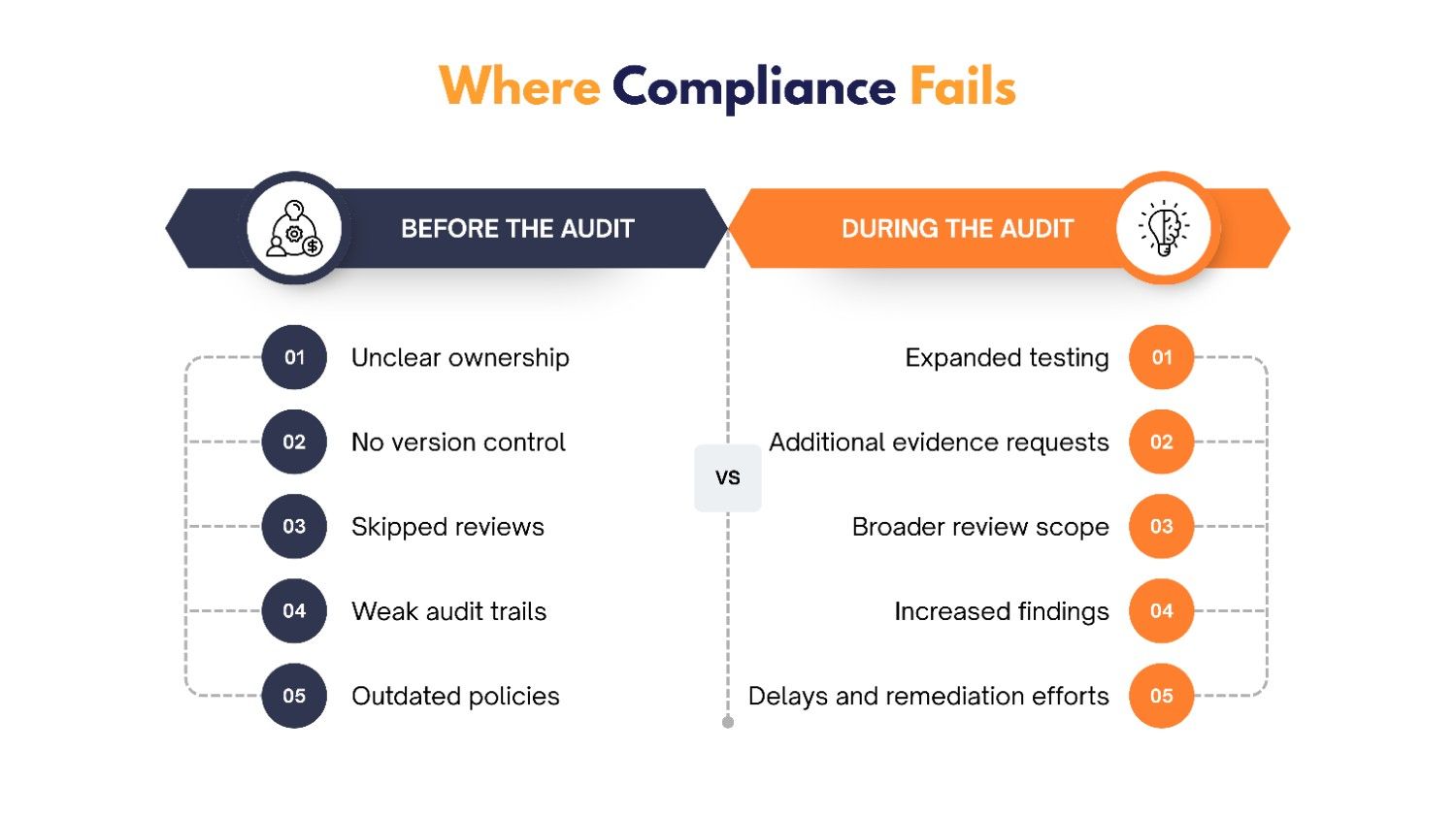
Infographic Concept: The Anatomy of a Documentation Gap
Where Compliance Fails
Fix-It Checklist
- Assign policy owners
- Implement proper version control
- Schedule and document reviews
- Formalize approvals
- Retire obsolete policies
Small documentation gaps don't stay small. Left unresolved, they compound.
Closing Thought
Compliance doesn't unravel in the audit room.
It unravels quietly.
In the policy nobody updated.
In the approval nobody recorded.
In the version history nobody preserved.
By the time an auditor finds those gaps, your documentation has already told your story.
The better question is whether you've shaped that story intentionally.
Tighten your documentation practices now, while you have the breathing room to do it right.
Because once the audit clock starts, the record you've built or failed to build is the only one that matters.
Tighten your documentation practices now
Because once the audit clock starts, the record you've built or failed to build is the only one that matters.
Talk to CyberCube