Consider the confusion regarding the two frameworks for a moment. If you have worked in security or compliance at all then you have most likely seen instances of both happening: An organization has a SOC 2 Type II report but gets broken into anyway and an organization spends 14 months working toward HITRUST certification and ends up still having gaps in their core systems.
So, while the report exists; the risk of being broken into does not go away. Therefore, before you allocate utilization of your budget, resources and annual effort from your team, you should ask yourself the question: Which of the two frameworks have more impact on making an organization that is less likely to be broken into?
With that being said you should also consider what the results of answering that question might look like in 2026.
Which of the two frameworks have more impact on making an organization that is less likely to be broken into?
The real risk isn't picking the wrong framework. It's treating compliance as a destination instead of a continuous process and finding out what you missed when an attacker does.
The Honest Difference Between These Two Frameworks
SOC 2 gives you flexibility. That's genuinely useful and also the thing that makes it easy to game.
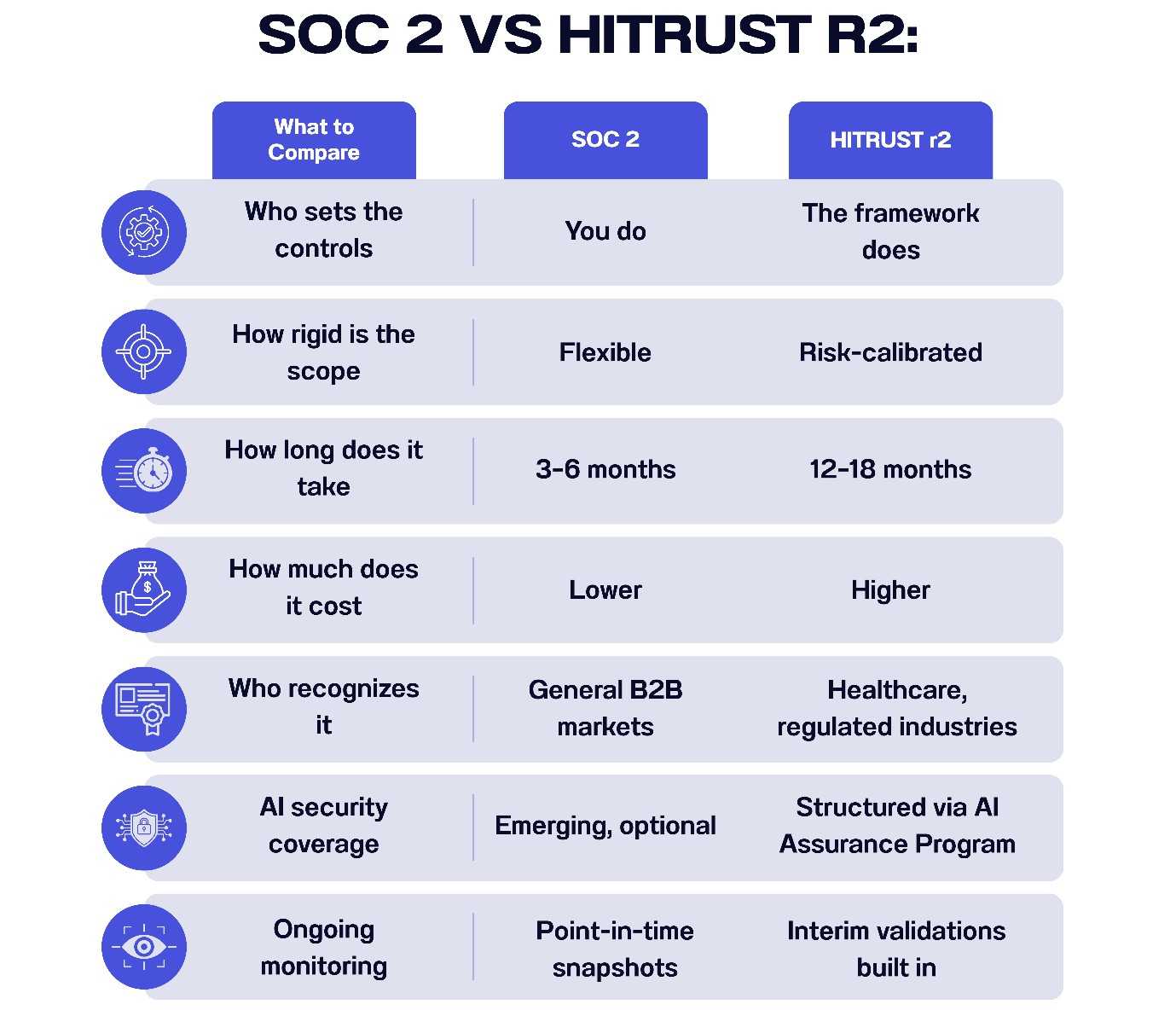
When you pursue SOC 2, you define your own controls, your own scope, and your own criteria. Your auditor evaluates whether what you said you'd do is what you actually did. But nobody's telling you what you should be doing in the first place. Two companies can both carry SOC 2 Type II reports with wildly different security programs underneath them — one serious, one barely above baseline and both technically pass.
HITRUST works the opposite way. The framework tells you exactly which controls apply to your organization based on your size, the type of data you handle, your regulatory environment, and your risk factors. You don't get to opt out of the hard stuff. The current version, CSF v11.3, includes everything from endpoint protection to — notably for 2026 — structured AI security controls that SOC 2 hasn't caught up to yet.
That difference in philosophy is the entire ballgame.
Quick Comparison: What You're Actually Getting
Why HITRUST Wins on Breach Risk (In the Right Context)
When you're trying to reduce breach risk, consistency matters more than flexibility.
With SOC 2, the bar shifts depending on who wrote the controls. With HITRUST, every certified organization has cleared the same threshold — verified by an external assessor who knows the framework inside out. That standardization isn't bureaucratic overkill. It's what makes the signal meaningful.
There's also the continuity factor. SOC 2 Type II reviews a defined window of time, usually six to twelve months. Once the period closes, you're essentially coasting until the next report cycle. HITRUST's r2 certification includes an interim validation at the midpoint of your two-year window, so your controls stay actively scrutinized, not just filed away.
And then there's the inheritance piece, which doesn't get talked about enough. If your infrastructure runs on a cloud platform that already holds HITRUST coverage like AWS, Azure and others — you can inherit validated controls directly through the MyCSF platform. SOC 2 has no equivalent. In an environment where your attack surface is largely shared infrastructure, that matters.
But SOC 2 Isn't the Wrong Answer for Everyone
None of this means you should immediately start an HITRUST r2 pursuit.
SOC 2 is the right move when your buyers aren't asking for HITRUST by name. If you're a SaaS company selling to mid-market B2B clients, a clean SOC 2 Type II report will get you through most vendor security reviews without issue. It's faster to achieve, cheaper to maintain, and widely understood across industries that aren't healthcare-specific.
It also makes sense when speed is a real constraint. If you need to close enterprise deals this quarter and your prospect's security questionnaire is asking for a compliance report, SOC 2 gets you there without an 18-month runway.
A lot of organizations use SOC 2 as the foundation and build toward HITRUST as they move upmarket or into regulated industries. That's not a compromise but a reasonable sequencing strategy.
When HITRUST Becomes Non-Negotiable
There are situations where SOC 2 simply won't hold up anymore.
If you handle protected health information, you're a business associate under HIPAA, or you're actively selling into health systems, payers or government agencies — you're going to hit HITRUST requirements contractually. Larger health systems have started requiring it, not just preferring it because "We have a SOC 2" is no longer the answer they're looking for.
HITRUST also carries weight in cyber insurance conversations. Carriers are paying more attention to the maturity of your security program, and HITRUST certification is one of the cleaner signals that your controls have been independently validated to a rigorous standard. That can translate to better coverage terms.
And if your organization has been through a breach or a regulatory action, HITRUST provides a visible, credible path to demonstrating that you've taken remediation seriously. It's hard to dismiss 2,000+ control requirements verified by a trained external assessor.
The Mistake That Undermines Both Frameworks
Here's the part that doesn't get said enough: the framework doesn't protect you. The controls do.
Organizations pass HITRUST assessments with documented policies that nobody actually follows. They achieve SOC 2 reports scoped so narrowly that their most sensitive systems are nowhere near the audit. In both cases, the report says "compliant" — and the breach happens anyway because the controls weren't real.
A useful question to pressure-test your program: Would our current controls have caught the attack patterns that hit our industry in the last 12 months? If you can't answer that clearly, the framework choice is almost beside the point.
Both HITRUST and SOC 2 are tools. They work when the team behind them is building genuine security, using the assessment process to find and fix real gaps — not just produce a document.
What to Actually Do with This
You haven't picked a framework yet: Pull the last three vendor security questionnaires from your most important prospects. Count how many ask for HITRUST by name versus a SOC 2 report. Let the market tell you where to start.
You have SOC 2 today: Run a gap analysis against HITRUST CSF v11.3. The delta is almost always larger than expected — and knowing it early saves you from scrambling when a health system asks for HITRUST on a deal you can't afford to lose.
You're already HITRUST-certified: Check your interim assessment documentation now. Gaps at the interim validation are the most common r2 failure point heading into 2026. Don't assume your initial assessment work carries you through.
You're managing third-party risk: If a vendor touches PHI, a SOC 2 report alone isn't sufficient assurance anymore. Require HITRUST i1 or r2 — and build that into your contracts before the conversation gets uncomfortable.
HITRUST provides stronger, more consistent breach risk reduction — especially in healthcare and regulated markets. SOC 2 is faster, more flexible, and perfectly adequate for a wide range of B2B environments.
The real risk isn't picking the wrong framework. It's treating compliance as a destination instead of a continuous process and finding out what you missed when an attacker does.
Pick the framework that fits where your business is going, build controls that actually work, and stop optimizing just for the certificate.
Pick the framework that fits where your business is going
Build controls that actually work, and stop optimizing just for the certificate.
Talk to CyberCube