.jpeg)
Nowadays, almost every activity is happening on the internet, right? Shopping, online orders for our favorite meals, banking, sharing photos with friends and family on social networks- it’s undeniable! Businesses are always gleaning information about their customers from the web on a regular basis, frequently without their customers ever realizing how much data they have divulged.
Let's reflect on this!
Whether individuals are signing up for newsletters, downloading apps, making payments via the Internet, accepting cookies on a website, or any other such action on the digital domain, a data trail of their activities is invariably created. Eventually, people had to ponder a critical question:
“Where does my data go once I share it?”
This query birthed the establishment of laws such as GDPR, CCPA, and the DPDP bill, the proposed Data Protection, and Privacy Bill by India’s government.
These acts stipulate certain conditions that will compel businesses to behave in a responsible, open, and prudent manner with the information that their customers willingly provide. However, for most companies, especially start-ups and expanding e-commerce enterprises, comprehending these directives can appear challenging and daunting.
Are all the provisions applicable to your organisation?
What if your organisation is situated in the heart of India, but your clientele spans across international borders?
What if you only collect email addresses of your website users?
Let's declutter everything.
Why Data Privacy Has Become Such a Big Deal
A few years ago, nobody shared their personal info on the web. Then things began to change. Customers know the score now.
Why does this firm need my information? How long can it be retained? Is it shared with a different party? - And last - Is it secure?
And really - this is reasonable, isn’t it? Who hasn’t noticed the news on information leakage, hacked web sites, phishing calls, or a business profiting from individual information? Any security breach will have lasting effects in years of gained customer faith. These days - the worldwide government is increasingly imposing more privacy measures.
Not simply to defend people however also to prompt companies toward better business behavior.
Understanding GDPR: Europe’s Strict Privacy Law
Privacy laws: GDPR is what people are usually referring to when discussing privacy regulations. The GDPR – or General Data Protection Regulation – is an EU directive launched in May 2018 and fundamentally modified the way companies approach customer data. What's particularly critical to recognize regarding GDPR is the fact that it applies not only to businesses with roots in Europe. Any company that processes or holds data for anyone living within the EU-regardless of whether your organization is headquartered in the U.S., India, or somewhere else entirely-may be bound by the GDPR.
Let’s take an example:
Imagine you run an Indian online clothing store, and customers from Germany and France can place orders through your website.
You collect their:
- Names
- Phone numbers
- Addresses
- Payment details
That means you’re handling the personal data of EU residents and GDPR enters the picture.
What Makes GDPR So Strict?
GDPR focuses on giving users control over their own information.
Under GDPR, people can:
- Ask what data you have about them
- Request corrections
- Ask you to delete their information completely
- Withdraw consent anytime
In short, businesses cannot quietly collect and use data anymore. They need to be transparent about everything.
And yes, the penalties are serious too. Companies can face fines worth millions of euros for non-compliance, which is why GDPR became a wake-up call for businesses worldwide.
Understanding India’s DPDP Act
The world of privacy regulation had official Indian footing with the notification of the Digital Personal Data Protection Act, 2023 (DPDP Act). Taking into account the humungous rate at which the Indian digital economy is expanding, this legislative piece was rather late and needed for a while.
Considering how rapidly India’s digital economy is growing, this law was long overdue.
Today, millions of Indians use:
- UPI apps
- E-commerce platforms
- Online learning websites
- Healthcare apps
- Digital banking services
And all these platforms collect enormous amounts of personal data every day.
The DPDP Act was introduced to ensure that businesses treat this data responsibly.
So, Who Needs to Follow DPDP?
If your organization processes digital personal data in India, the law likely applies to you.
Even foreign companies may fall under DPDP if they offer services to people in India.
Example:
Suppose a US-based fitness app targets Indian user and collects:
- Names
- Mobile numbers
- Health preferences
- Payment details
That company may still need to comply with India’s DPDP requirements.
What Does DPDP Mainly Focus On?
At its core, DPDP is built around one simple idea:
People should have control over their personal data.
Businesses must:
- Take proper consent before collecting data
- Use data only for the stated purpose
- Protect user information from misuse or breaches
- Provide ways for users to correct or delete their data
An organization that handles/processes information of an individual are called a “Data Fiduciary” as per this Law. The term “Fiduciary” gives emphasis to accountability and to the sense of trust of a customer on the organisation. And similar to GDPR, fines are hefty if a breach has occurred and organizations can get fined till 250 crore for every violation.
Understanding CCPA: California’s Consumer Privacy Law
In the next part, let us make our move to the USA. USA is a state to the one that is different from that of EU as there is not any national law regarding privacy as such, but it is states that make up the country that have had such rights established.
One of the most known ones being:
CA – California Consumer Privacy Act (CCPA): California state has been in possession of this particular legislation from the beginning of year 2020. CCPA primarily centers towards consumer privacy rights and rights of transparency.
What Makes CCPA Different?
CCPA’s primary concern involves selling consumer data to third parties and also selling it. That's how the online advertising industry had evolved to grab browsing behaviors and data and then sell it to others on what most consumers never intended.
Californians regulated by CCPA have the right to:
- Ask companies what data they collect
- Request deletion of personal information
- Opt out of data selling
- Access their stored information
That’s why you often see website links saying:
“Do Not Sell My Personal Information.”
That requirement largely comes from CCPA.
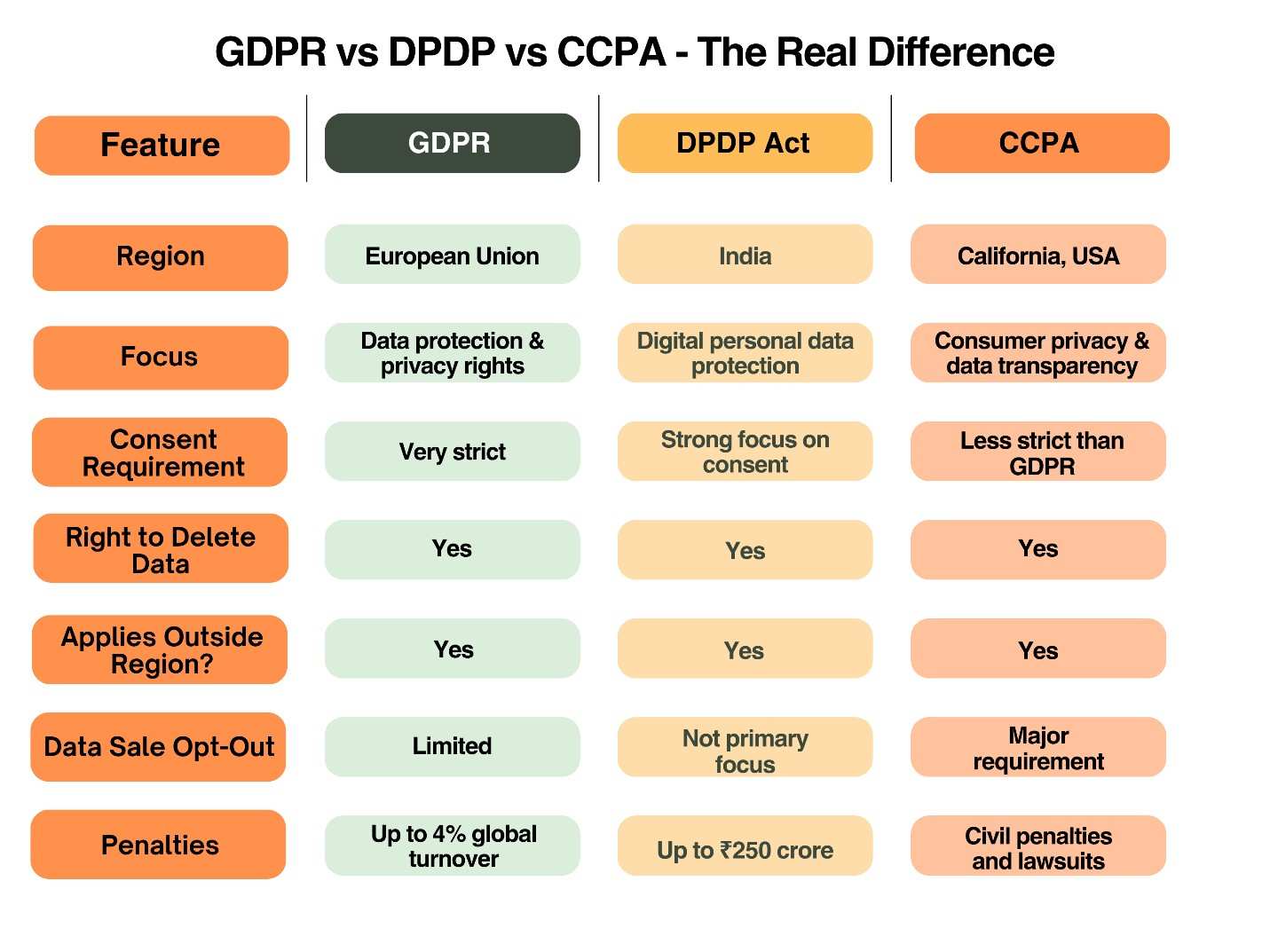
GDPR vs DPDP vs CCPA — The Real Difference
All the three have one common aim i.e. The user privacy but their strategies are somewhat different.
- GDPR is more concerned on the consent and rights of the user.
- DPDP aims to govern the safe and reasonable processing of the personal digital data within India.
- CCPA is more towards user and consumer rights and to ensure how the sharing or selling of data to any third party is being carried out.
Which Law Applies to Your Business?
This is where the biggest problem exists. It typically comes down to three variables.
1. Where Are Your Users Located?
If your customers are based in:
- Europe → GDPR may apply
- India → DPDP may apply
- California → CCPA may apply
Your business location matters less than the location of your users.
2. What Data Are You Collecting?
Even basic information like:
- Email addresses
- Contact numbers
- IP addresses
- Cookies
- Location data
can bring your business under privacy regulations.
A popular misconception: “We only collect minimal amounts of data, so these privacy laws don’t impact us.” The reality: not always the case.
3. How Are You Using the Data?
If your business:
- Tracks users online
- Runs targeted ads
- Shares data with third-party vendors
- Stores customer information
- Uses analytics tools
then privacy compliance becomes extremely important.
Can More Than One Privacy Law Apply at Once?
Absolutely, and that’s actually the new normal. In fact, let’s think of a hypothetical tech startup that sells to customers all over Europe. Their customers have accounts set up while the company is primarily doing business operations in India. And they’re even doing ad campaigns and running traffic for California users.
Suddenly, this one company has to comply with three sets of rules: GDPR, DPDP and CCPA. That’s why businesses increasingly focused more and more on robust global privacy instead of checking a box for privacy compliance as a sort of once-off activity.
What Businesses Should Start Doing Today
The best thing about it is that compliance doesn’t necessarily have to mean complicated legal procedure. Many times, it begins simply with education and the adoption of new habits. Every organization should pay attention to this:
Understand What Data You Collect
You cannot protect data if you don’t even know where it exists.
- Keep Privacy Policies Clear: Nobody likes reading complicated legal jargon. Simple and transparent communication builds trust.
- Strengthen Security Measures: Good cybersecurity practices are now directly connected to privacy compliance.
- Take Consent Seriously: Users should clearly understand what they’re agreeing to.
- Train Employees: Many privacy incidents happen because of human mistakes, not technology failures.
This Privacy law thing is no longer the issue of just big tech. Even the small business, startups, online stores and the mobile apps are supposed to act on this. And frankly, that’s a good thing. Ultimately, the user will simply want to be convinced that his / her data is safe with you.
So be it GDPR, DPDP or CCPA – All these privacy laws deliver the same message. Respect User privacy. Be transparent. And Earn the trust.
After all, in this digital age, trust is one of the most valuable currency a business could acquire.
Build a Practical Privacy Compliance Plan
Respect User privacy. Be transparent. And Earn the trust.
Talk to CyberCube