Both standards carry real weight in enterprise sales conversations. Both signal that your organization takes governance seriously. But they address entirely different problems and conflating them can leave you exposed in ways that are surprisingly easy to miss.
"We already have ISO 27001 do we also need ISO 42001 now that we’re using AI?" We hear this from clients regularly, and it’s a fair question. A lot of organizations are sitting in exactly that position right now: a mature security posture, a growing AI footprint, and uncertainty about whether existing certifications are enough.
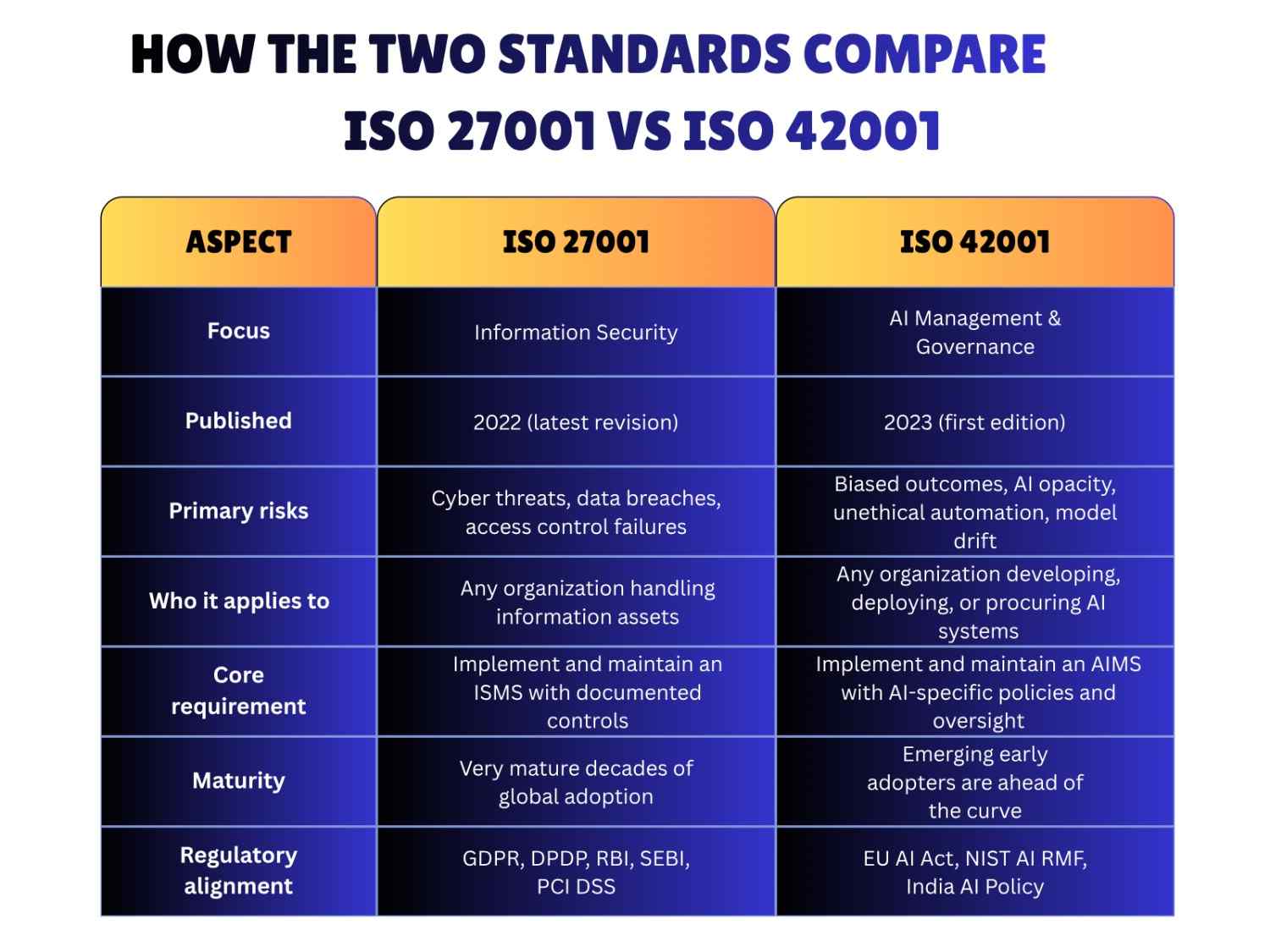
The short answer is that these two standards are not competing for the same territory. ISO 27001 is about protecting your information. ISO 42001 is about governing your AI. Think of it like the difference between a fire safety system and a financial audit both essential, but for reasons that have nothing to do with each other.
What ISO 27001 Actually Does
ISO 27001 has been the benchmark for Information Security Management Systems since 2005, and for good reason. If your organization holds customer data, financial records, employee information, or any kind of sensitive business asset, the standard gives you a structured methodology to protect it. That means identifying what you hold, understanding the threats to it, putting controls in place, and committing to continuous improvement not as a one-time project, but as an ongoing discipline.
The 2022 revision extended coverage into areas that were gaps in the original: cloud security, threat intelligence programs, and more granular supplier risk management. In practice, the standard touches:
- Access control and identity management
- Data encryption and secure transmission
- Physical security of systems and infrastructure
- Incident response and business continuity planning
- Third-party and supplier risk management
- Cloud security (added in Annex A 2022)
- Threat intelligence programs
At its core, ISO 27001 asks one question: are you protecting the information you’re responsible for, and can you prove it consistently?
What ISO 42001 Does Differently
ISO 42001 was published in December 2023, making it the world’s first international standard purpose-built for Artificial Intelligence Management Systems. Its arrival was overdue. AI is now embedded in hiring tools, credit decisions, medical diagnostics, fraud detection, and a hundred other high-stakes processes but until 42001, there was no widely recognized framework for managing it responsibly.
Where ISO 27001 asks “is your data safe?”, ISO 42001 asks something fundamentally different: is your AI trustworthy, transparent, and being used responsibly? The risks it addresses are not cyber risks. They are governance risks, ethical risks, and accountability gaps that firewalls simply cannot touch.
The standard covers:
- AI risk assessment what could go wrong when your AI makes a decision?
- Transparency and explainability can you articulate why the AI reached a particular outcome?
- Bias and fairness are your models producing equitable results across different groups?
- Data quality governance is the training data clean, current, and representatively sourced?
- Human accountability who owns the outcome when the AI is wrong?
- Lifecycle management how do you monitor, update, and responsibly decommission AI systems?
- Third-party AI risks what about AI tools you procure from vendors or consume via API?
One practical note worth flagging: ISO 42001 follows the same Annex SL high-level structure as ISO 27001. If you already have 27001 in place, the management system architecture will feel familiar, and integration is considerably more straightforward than starting from scratch.
How the Two Standards Compare
A Concrete Way to Picture It
Imagine you run a hospital. ISO 27001 is your security system locks on the doors, firewalls on the servers, controlled access to patient records. Nobody walks in without authorization.
ISO 42001 is your medical ethics board. If you’re using AI to help diagnose patients or suggest treatment plans, the ethics board asks harder questions: Is this AI making fair recommendations across different patient demographics? Can the clinicians understand why it flagged a particular drug interaction? What is the accountability chain when it’s wrong?
The key point: you can have a flawless security posture ISO 27001 certified, audited annually, zero incidents and still be running an AI system that discriminates, produces unexplainable outputs, or makes consequential decisions with no human in the loop. ISO 27001 was never designed to catch that. ISO 42001 is.
Where the Differences Show Up in Practice
The risk language is different
In ISO 27001, you’re asking: what if a bad actor gets into our network? What if an employee exfiltrates data? What if a vendor’s system is compromised?
In ISO 42001, the questions shift entirely. What if our model was trained on biased data and we don’t know it? What if a regulator asks us to explain an automated decision and we can’t? What if real-world data has drifted from the training distribution and the model is quietly degrading? These aren’t cybersecurity problems. No amount of network segmentation protects you from them.
Data is treated very differently
ISO 27001 treats data as something to protect. Confidentiality, integrity, availability the CIA triad underpins everything.
ISO 42001 treats data as something to govern. Is your training data representative of the population it will affect? Is it ethically sourced? Is it current? Does using it create legal or reputational risk downstream? Those are fundamentally different questions, and they require fundamentally different governance structures.
Accountability works differently
With ISO 27001, accountability is relatively well-defined your CISO, IT team, and data protection officer typically own the controls.
With ISO 42001, you have to work out who is accountable for AI decisions. Is it the data scientist who built the model? The business unit that deployed it? The leadership team that approved it? The vendor who sold it? Often the answer is “all of the above,” and ISO 42001 pushes you to formalize that chain before something goes wrong, not after.
Do You Need Both?
That depends on what your organization actually does, but the pattern is fairly consistent.
You almost certainly need ISO 27001 if you handle customer data, operate in a regulated industry like finance, healthcare, or payments, or if your enterprise clients are asking for proof of security practices. At this point in the market, ISO 27001 is a baseline requirement for most serious B2B conversations globally.
ISO 42001 becomes relevant and increasingly urgent if your organization is building AI products, using AI to make decisions that affect customers or employees, procuring AI tools from third parties, or selling to European enterprise clients who are now operating under the EU AI Act.
If you’re a SaaS company, a fintech, or an AI-enabled service provider operating in regulated markets, the honest expectation is that you’ll eventually need both. Having them in combination isn’t a box-ticking exercise it tells clients something specific: that you’re rigorous about information security and rigorous about how you handle AI. Those are two distinct credibility claims.
A Real Example
One of our clients a mid-sized Indian SaaS company selling to European enterprises had ISO 27001 in place for three years when they started integrating a large language model into their product. Within weeks, their EU clients were asking about AI governance policies. ISO 27001 didn’t cover it. That was the moment ISO 42001 went from “interesting to watch” to “we need this now.” The conversation had changed; the certification hadn’t kept up.
What Implementation Actually Involves
If you’ve been through ISO 27001, you know the rhythm: policies, procedures, risk registers, statements of applicability. ISO 42001 follows the same pattern, but the artefacts are different.
For ISO 42001, you’ll typically need to develop:
- An AI policy your organization’s stated position on responsible AI use
- An AI risk register cataloguing your AI systems and the specific risks each one carries
- Algorithmic impact assessments particularly for high-stakes decisions in credit, hiring, or medical contexts
- Data governance documentation for training datasets
- Incident response procedures specific to AI failure modes
- A defined accountability structure for AI oversight
- Supplier questionnaires for third-party AI tools
The good news, if you’re already ISO 27001 certified: a large part of the foundation is already built. Your management system structure, internal audit processes, and leadership commitment all carry over. The ISO 42001 rollout becomes more about extending existing practice than starting from scratch.
The Regulatory Context
This is worth keeping in view. The EU AI Act came into force in 2024 and creates specific obligations for “high-risk AI systems” the kind of AI used in hiring, credit scoring, healthcare, and law enforcement. ISO 42001 aligns closely with those obligations, which is why EU-facing organizations are moving on it now rather than waiting.
In India, the government has signaled its intent to regulate AI through MEITY’s advisory framework and the Digital India Act. Organizations that establish responsible AI governance now will be considerably better positioned when mandatory requirements arrive.
Meanwhile, ISO 27001 continues to be directly referenced by SEBI CSCRF, the DPDP Act, and RBI guidelines. Its relevance isn’t diminishing if anything, the regulatory environment is reinforcing it.
Where the Two Standards Overlap
For all their differences, ISO 27001 and ISO 42001 have meaningful common ground which is part of why running them together is efficient rather than duplicative.
- Risk management approach: Both are built on identifying, assessing, and treating risks. The risk methodology you’ve developed for 27001 adapts naturally to AI-specific risks.
- Management system architecture: The same Annex SL structure context of organization, leadership, planning, support, operation, performance evaluation, improvement underpins both.
- Third-party management: Both require you to think carefully about suppliers and vendors, whether they’re handling your data or providing AI tools you’re building on top of.
- Internal audit and management review cadences: The audit rhythm is the same, so they can run in parallel without doubling the overhead.
- Documentation and record-keeping: Your existing document management system extends naturally to cover the additional artefacts ISO 42001 requires.
Where to Start
ISO 27001 and ISO 42001 are not competing frameworks. They are complementary responses to two different categories of risk that now coexist in most organizations: information risk and AI risk.
For organizations starting the compliance journey, ISO 27001 is typically the right first step. It’s more mature, more widely demanded by clients and regulators, and provides the management system foundation that makes ISO 42001 faster and cheaper to implement when you’re ready.
But if AI is already embedded in your products, your operations, or your vendor stack, the time to start thinking seriously about ISO 42001 is now not when a client asks the question or a regulator requires an answer.
At CyberCube, we’ve supported organizations across India, the Middle East, and globally through compliance programs like these. Whether you’re starting out or looking to extend an existing ISMS to cover AI governance, we’re glad to have a conversation about what the right path looks like for your specific situation.