Keeping up with data privacy can feel like chasing a moving target. The rules, risks, and expectations are always changing. That’s why the arrival of ISO/IEC 27701:2025 is such a big deal for organizations everywhere. Think of it as a fresh playbook for anyone who wants to manage personal information the right way. This new version doesn’t just replace the old 2019 standard as it makes privacy governance easier, more practical, and open to more businesses than ever before.
This guide will take you through the changes to ISO/IEC 27701:2025, making it easy for you to see exactly what has changed and why those changes are important to your business The revised document will contain many examples of how you can successfully carry out your planned updates and therefore make the implementation of these changes as easy as possible. There will be an added level of confidence following the review of this guide in respect to your ability to comply with the rules of privacy regarding the use of personal data. Finally, a clear path forward for you to develop customer trust will be established following this document.
What does ISO/IEC 27701:2025 mean to you?
The ISO/IEC 27701:2025 standard is a document that organisations can refer to when they are unsure about how to implement the necessary measures to safeguard and control the handling and/or transfer of an individual's personal information, as well as how to implement such safeguards. It gives guidance on the kinds of areas that must be included in a privacy framework (policy, processes and PIMS) to be able to show their commitment to maintaining an individual's right to privacy. For companies that handle names, email addresses or any other type of personally identifiable information (PII), this standard should not be viewed as a "nice-to-have," but rather a means to align the company with global privacy regulations and build customer confidence in the company's ability to manage their personal information appropriately.
So, what exactly is a PIMS? Picture it as your organization’s privacy game plan—a set of practical policies and habits that help you spot and handle data privacy risks before they create headaches. The best part about the new 2025 standard? It steps things up by letting you build this system on its own, without needing to jump through the extra hoop of getting ISO/IEC 27001 certified first. Now, just about any company can chase PIMS certification when they’re ready, not just the ones with big security credentials.
Changes from the 2019 to the 2025 Version
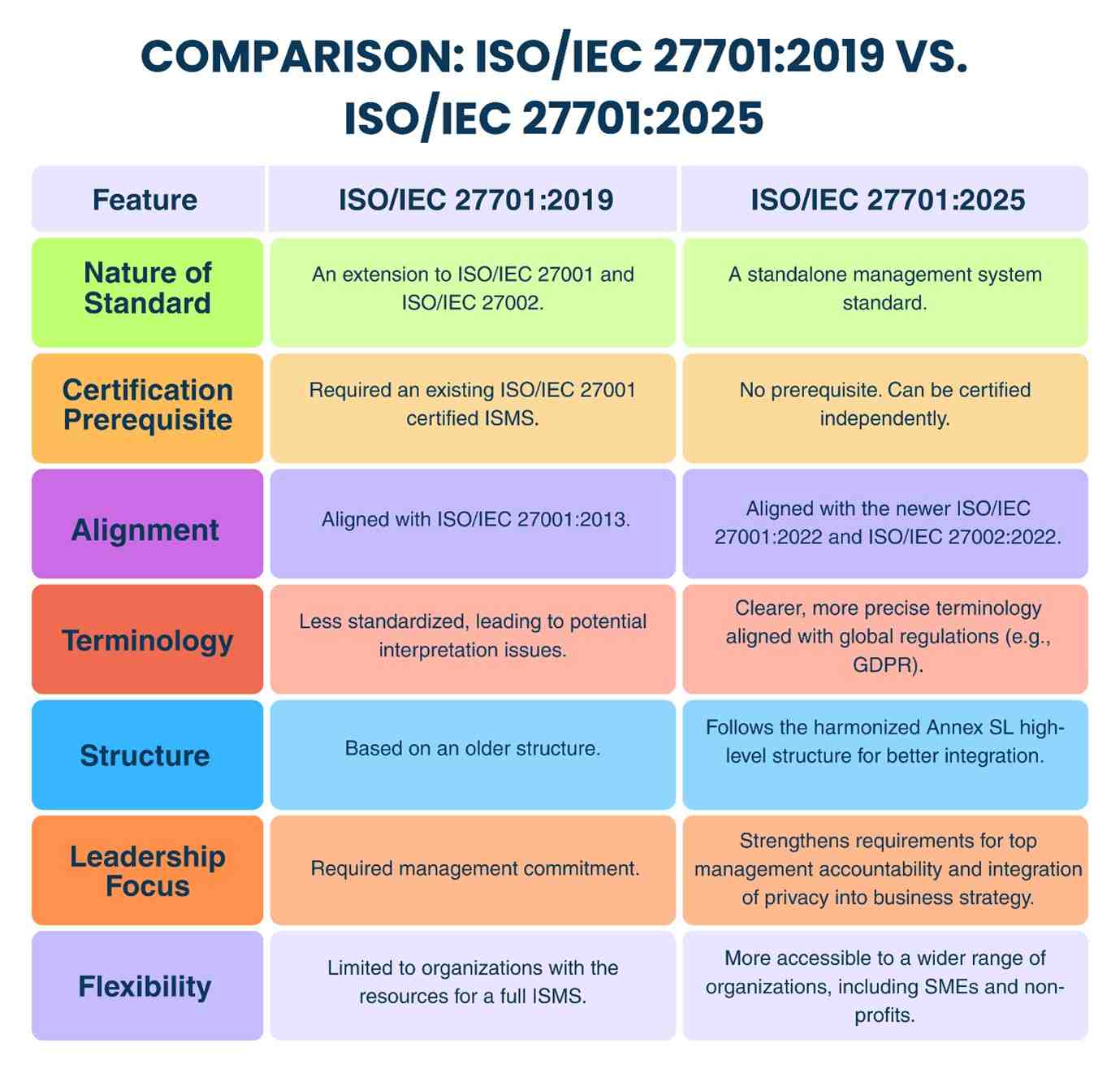
The 2025 update shakes things up by bringing more flexibility and making privacy management a lot clearer and easier to wrap your head around. In the past, the 2019 standard was kind of like an add-on, you needed to have an Information Security Management System (ISMS) already in place before you could even think about privacy certification. Now, with the 2025 version, privacy gets its own spotlight. You can build a PIMS from scratch without all the extra security layers, which is great news for anyone who felt locked out before.
Let’s run through some of the points you’ll want to know about:
1. A Standalone Standard
Here’s the biggest shift: ISO/IEC 27701:2025 isn’t just riding shotgun anymore—it’s driving its own car. You no longer have to bolt it onto an existing ISO/IEC 27001 ISMS just to get going. That might sound like a small technical difference, but for a lot of organizations—especially mid-sized companies or those who just care deeply about privacy—it’s a total game-changer. Now, you can go after PIMS certification all on its own, without taking on a bunch of extra security requirements you might not need. In other words, this new setup helps more businesses get into the privacy game, no matter their size or industry focus.
2. Enhanced Alignment with ISO 27001:2022
Even though ISO/IEC 27701:2025 can stand on its own now, it still plays nicely with the latest ISO/IEC 27001:2022 (for information security management systems) and ISO/IEC 27002:2022 standards. It’s a smoother, more connected way to handle governance, and it saves you from reinventing the wheel every time something changes.
3. Clearer Structure and Terminology
You’ll notice there’s a distinct difference between requirements that use “shall” and those that use “should” or “may”. When you see the word “shall” in the Standards, there are absolutely no exceptions and you are required to comply with the Standard. The use of the word “should” or “may” allows for a measure of discretion with regard to compliance; hence, the rewrite eliminates the ability to interpret each requirement differently, allowing greater accuracy when you’re performing audits and implementing the requirements of the Standard.
4. Strengthened Clause Requirements
You’ll also notice that the main rules—Clauses 4 through 10—are now a lot easier to follow and put into practice. The 2025 version provides a more concise version of the information you actually need instead of a page full of technical language. Rather than providing a comprehensive overview or exhaustive guide, it provides you with "checkpoints" on how to practically implement your privacy program in a real-world environment consistent with what companies are experiencing on a daily basis.
• Clause 5 (Leadership): Places more emphasis on the accountability of senior leadership to govern the privacy of their organisations.
• Clause 6 (Planning): Incorporates a greater depth of risk-based thinking in how organisations approach privacy management.
• Clause 9 (Performance Evaluation): Includes more details on creating measurement instruments for privacy and the ongoing review of privacy management at the executive level.
Comparison: ISO/IEC 27701:2019 vs. ISO/IEC 27701:2025
Why the ISO/IEC 27701:2025 Update Matters for Your Business
Broader Accessibility
By dropping the requirement to have ISO/IEC 27001 in place first, this new standard completely opens up the playing field. Now, tons of organizations who care about privacy but don’t really need a full-on security certification can jump in. That’s huge for SaaS providers, tech startups, nonprofits, and really anyone who just wants a practical way to show they take privacy seriously. Instead of being boxed out by extra rules, you’re finally free to focus on privacy in a way that actually fits your business.
Stronger Regulatory Alignment
What really stands out about the new framework is how its language and structure now fit much better with privacy laws like GDPR and CCPA. In plain English? It gives you a clear, practical way to show that you’re on top of those rules—no more scrambling when a regulator comes knocking. Instead, you’ll be able to point to your PIMS and say, “Look, we’re not just claiming compliance—we’ve built it into how we operate.” That makes getting ready for audits a whole lot less stressful and shows customers you’re serious about doing privacy the right way.
Improved Auditability
Now that the line between what’s required and what’s just a suggestion is crystal clear, there’s way less room for mix-ups. Auditors—whether they’re part of your team or coming in from the outside can measure your PIMS by straightforward, easy-to-understand standards. That means audits aren’t just smoother, but you actually get more reliable results every time.
Enhanced Governance and Accountability
When leadership actually gets involved, privacy stops being just another box for the IT or legal team to check—it becomes something baked into the entire company strategy. This update makes sure privacy isn’t just a side project but a part of your business’s DNA Encouraging thorough privacy-by-design thinking is needed so that all decisions regarding an individual’s data can be integrated naturally into every aspect of their life and not merely an afterthought.
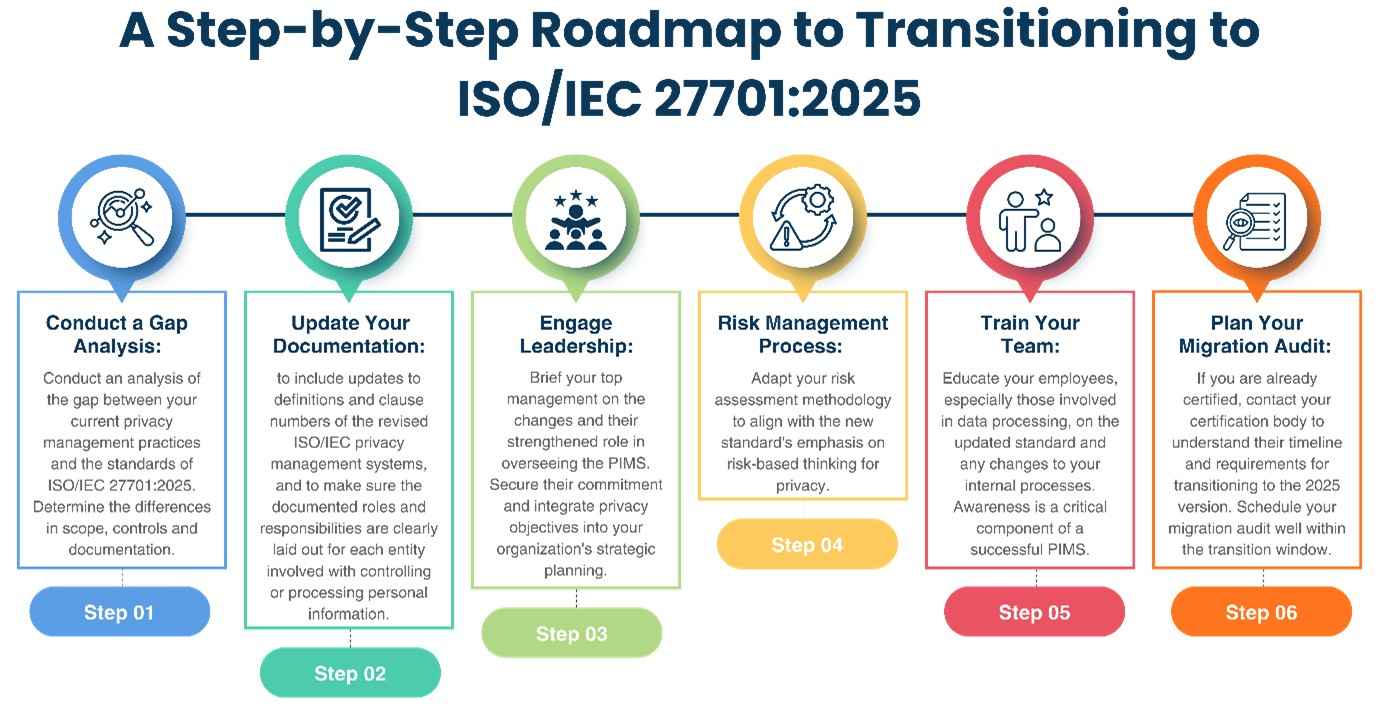
So, if you are ready to start planning for your move, here's an outline of how to transition to the 2025 privacy management systems certification, step-by-step:
Embrace the New Standard for Privacy Excellence
Whether you are just beginning to build your privacy program or whether you want to improve upon your existing privacy program, utilizing the new standard will help you to create a privacy program that will be able to withstand challenges and that will be trusted by your clients and partners. So go ahead and make this investment in your future! You will be glad that you did when others notice how much you care about their Privacy.
Embrace ISO/IEC 27701:2025 for Privacy Excellence
Get expert support to build a PIMS, align with GDPR and CCPA expectations, and prepare for smoother privacy audits with a practical implementation roadmap.
Talk to CyberCube